Category Archive Analysis

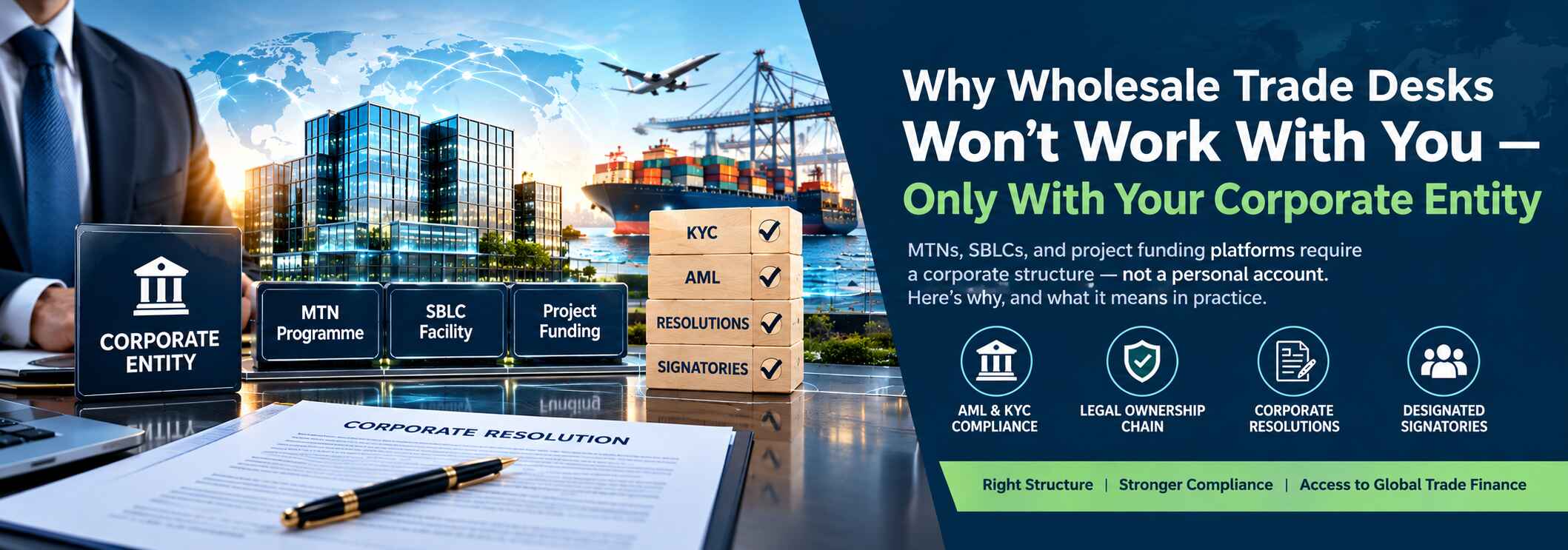
Why Wholesale Trade Desks Require a Corporate Entity

Corporate Entity  |  SPV  |  Wholesale Trade Desk  |  MTN  |  SBLC  |  AML / KYC Compliance  |  Trade Finance  |  Project Funding  |  Institutional Grade Accounts  |  Tier One Settlement  |  Corporate Entity  |  SPV  |  Wholesale Trade Desk  |  MTN  |  SBLC  |  AML / KYC Compliance  |  Trade Finance  |  Project Funding  |  Institutional Grade Accounts  |  Tier One Settlement  | 
Trade Finance  ·  Institutional Structure  ·  AML/KYC

Why Wholesale Trade Desks
Won't Work With You
Only With Your Corporate Entity

Every serious wholesale trade desk — every MTN programme, every SBLC facility, every project funding platform — operates under the same structural requirement. The capital instrument moves through a corporate entity or Special Purpose Vehicle. Not a personal account. Not a private banking relationship. A properly constituted corporate structure. Here is why, and what it means in practice.

Professional Insight 8 min read Trade Finance  ·  Corporate Structure  ·  Wholesale Banking

The most common reason a wholesale trade transaction fails before it begins has nothing to do with the capital, the instrument, or the counterpart. It has to do with the account the client is trying to use.

From professional experience working across wholesale banking, trade finance, and PPP for project funding at the institutional level, one pattern repeats with striking consistency: clients who have the capital, who have found a legitimate trade desk, and who are genuinely positioned to participate in an MTN programme or SBLC Trade for facilitating serious Project Funding — more often than not, find themselves unable to proceed because they are attempting to engage as an individual rather than as a properly constituted corporate entity.

This is not a technicality. It is not a bureaucratic preference. It is a hard structural requirement built directly into the AML, KYC, and compliance frameworks under which every legitimate wholesale trade desk, Tier One settlement bank, and serious trade platform operates.

Understanding why this requirement exists — and what it demands in practice — is the difference between an engagement that proceeds and one that stalls permanently.

The Core Principle

Trade platforms, compliance officers, and Tier One settlement banks operate under microscopic AML and KYC regulation. Moving serious capital instruments requires an institutional-grade account. Corporate accounts provide clear legal ownership chains, authorised corporate resolutions, and designated signatories that retail personal accounts simply cannot cleanly support.

Why Corporate Structure Is Non-Negotiable

The Three Reasons Wholesale Desks Require It

The requirement for a corporate entity or SPV is not arbitrary. It reflects three distinct compliance and operational realities that are built into the institutional infrastructure of wholesale trade finance.

01

Clear Legal Ownership Chains

AML regulations require wholesale counterparts to establish — with documentary certainty — who owns the capital being deployed and who benefits from the transaction. A personal account creates ambiguity that a corporate structure with properly documented Ultimate Beneficial Ownership resolves cleanly. The compliance team at a Tier One settlement bank needs a legal chain they can follow, document, and defend to their regulator. A corporate entity provides that chain. A personal account, in the context of instruments of this scale, does not.

AML Requirement
02

Authorised Corporate Resolutions

Wholesale trade instruments — MTNs, SBLCs, and the associated settlement mechanisms — require authorised signatories acting under documented corporate authority. A Board Resolution or Corporate Resolution authorising the transaction, naming the signatories, and establishing the scope of their authority is a standard prerequisite at every serious trade desk. This documentation does not exist for a personal account. It cannot be retrofitted. It exists only where a properly constituted corporate entity exists first.

KYC Requirement
03

Designated Signatories at Institutional Grade

The movement of capital instruments at wholesale scale requires designated signatories whose authority is legally constituted, verifiable, and specific to the transaction. Compliance officers at trade platforms and Tier One settlement banks will verify signatory authority independently. A corporate structure — correctly constituted, with current statutory documentation — provides this. A personal account, regardless of the wealth behind it, provides only a single individual whose authority to bind a transaction is legally ambiguous at institutional scale.

Institutional Grade Requirement
Professional Observation

In consistent experience across this space, the rejection of a transaction at compliance stage — after significant time has been invested by all parties — almost always traces back to one of two structural failures: the wrong bank, or the absence of an appropriate corporate entity. The capital is present. The appetite is genuine. The structure is missing.

A legitimate wholesale trade desk does not bend this requirement. A desk that claims it will accept a personal account for an MTN or SBLC transaction is telling you something important about its legitimacy.

The Instruments

MTNs and SBLCs — Why Structure Matters Even More

The corporate structure requirement applies across wholesale trade finance broadly. But it carries particular weight in the context of the two instruments most commonly sought by HNWIs accessing wholesale banking for the first time: Medium Term Notes and Standby Letters of Credit.

MTN

Medium Term Note

A debt instrument issued by a financial institution or corporate entity with a maturity typically ranging from one to ten years. In wholesale trade contexts, MTN programmes allow qualified participants to access capital markets at institutional terms — rates and structures unavailable at the retail or private banking level.

MTN programmes are issued to, and traded between, institutional counterparts. The issuing desk will not engage with an individual. The settlement bank will not accept instructions from a personal account. The instrument, by its nature, requires a corporate counterpart on the receiving side.

Why corporate structure is essential: MTN settlement involves interbank messaging between institutional accounts. Personal accounts are not participants in this infrastructure.

SBLC

Standby Letter of Credit

A guarantee instrument issued by a bank on behalf of a client, assuring a beneficiary that payment will be made if the client fails to fulfil a contractual obligation. In trade finance and project funding, SBLCs function as performance and payment guarantees that enable transactions that would otherwise require full capital commitment upfront.

An SBLC is issued on behalf of a corporate entity — not an individual. The issuing bank's compliance team will require full corporate KYC, corporate resolutions authorising the instrument, and designated signatories. The absence of any of these stops the issuance before it begins.

Why corporate structure is essential: the SBLC is a liability of the issuing bank on behalf of your entity. Banks do not issue liabilities on behalf of informal personal relationships.

Personal vs Corporate Account

What a Personal Account Cannot Do

The table below reflects the compliance reality at serious wholesale trade desks and Tier One settlement banks, based on professional experience in this space. It is not a regulatory citation — the specific requirements vary by institution and jurisdiction. It reflects consistent observed practice.

Requirement
Corporate Entity / SPV
Personal Account
UBO documentation
Cleanly structured, legally constituted
Ambiguous at institutional scale
Authorised resolutions
Board / Corporate Resolution available
Cannot be provided
Designated signatories
Legally constituted, verifiable
Individual only — authority ambiguous
MTN programme participation
Eligible counterpart
Not accepted by issuing desks
SBLC issuance
Issued on behalf of entity
Not issued on personal accounts
Tier One settlement
Accepted in interbank infrastructure
Outside institutional messaging rails
AML compliance clearance
Documented ownership chain
Insufficient for instrument scale
Project funding eligibility
Standard structure for project SPV
Not a recognised project counterpart
What to Do About It

The Correct Sequence of Steps

If you are a HNWI seeking access to wholesale trade finance — an MTN programme, an SBLC facility, or project funding at institutional scale — and you do not yet have the right corporate structure in place, the sequence matters as much as the steps themselves. Approaching a trade desk before the structure is ready wastes time, risks relationships, and in some cases permanently closes doors that might otherwise have opened.

  • 01

    Establish the Correct Corporate Entity or SPV

    The entity must be properly constituted in a jurisdiction that is accepted by the trade desk and settlement bank you intend to work with. Jurisdiction selection matters — not all corporate structures carry equal weight in the eyes of institutional compliance teams. This requires specialist legal advice. We advise on the basis that this step must be completed before any approach to a trade desk is made.

  • 02

    Ensure the Entity Has the Right Banking Infrastructure

    A corporate entity without a Tier One correspondent bank account is only half the solution. The entity's operating and settlement account must sit at an institution whose compliance standing is accepted by the wholesale counterpart. This is the precise gap our Tier One Trade Account Opening Service addresses — at the corporate entity level.

  • 03

    Prepare Full Corporate KYC Documentation

    This includes: Certificate of Incorporation, Memorandum and Articles of Association, current statutory registers, UBO declaration and supporting documentation, Board Resolution authorising the transaction and naming designated signatories, and proof of the entity's banking relationship. Every document must be current, certified where required, and prepared to the standard the receiving institution will accept — not the standard a company formation agent produces by default.

  • 04

    Approach the Trade Desk Through the Entity

    Only when the corporate structure is in place and the banking infrastructure is established should the approach to the trade desk be made. The approach should be made through professional channels — an unintroduced direct approach to a serious wholesale trade desk is rarely the right first move, regardless of how well prepared the documentation is.

Where You Are Now

Two Positions. Two Pathways.

✓  Structure in Place

You have a corporate entity and the right banking infrastructure

If your corporate entity is properly constituted, your UBO documentation is current, your authorised resolutions are in place, and your entity holds an account at a qualifying Tier One correspondent bank — you are positioned to approach a serious wholesale trade desk for MTN or SBLC access. The next step is a professional introduction to the right counterpart.

◈  Structure Not Yet in Place

You have the capital. The corporate infrastructure is missing.

If you have the capital and the intent but not the corporate entity, or if your entity lacks the right Tier One banking relationship, the trade desk conversation must wait. The structure comes first. We advise clients at this stage on what is required — and our Tier One Trade Account Opening Service addresses the banking infrastructure component at the corporate entity level specifically.

Transparency

The observations in this article are based on professional experience working in wholesale banking, trade finance, and institutional access — not on published regulatory standards that can be cited directly. Specific requirements vary by institution, jurisdiction, and the nature of the instrument being accessed.

What does not vary, in our experience, is the principle: legitimate wholesale trade desks require corporate entities. Any desk that tells you otherwise warrants careful scrutiny before you proceed further with them.

The corporate and legal structuring steps described here require qualified legal counsel in the relevant jurisdiction. We do not provide legal advice. We advise on the banking infrastructure component — the Tier One account at the corporate entity level — as part of our Tier One Trade Account Opening Service.


This article reflects professional observations in the wholesale banking and trade finance space and does not constitute legal, financial, or regulatory advice. Corporate structuring, instrument eligibility, and compliance requirements vary by jurisdiction, institution, and transaction type. Independent legal and financial advice should be obtained before proceeding with any trade finance or project funding transaction.

Structure First. Trade Second.

If you are ready to discuss the corporate banking infrastructure your entity needs to access wholesale trade finance, a confidential conversation is the right first step.

#TradeFinance #WholesaleBanking #SPV #MTN #SBLC #CorporateStructure #AML #KYC #HNWI #HNWI #ProjectFunding #PrivateWealth #TierOneBanking

Quantum Computing and Cryptocurrency: What You Need to Know

Quantum Computing  |  POST-Quantum Cryptography  |  NIST PQC STANDARDS 2024  |  Bitcoin ECDSA Vunerability  |  ISO 20022  |  CBDC Development  |  Financial Infrastructure  |  SHOR'S Algorithm  |  Quantum Computing  |  Post-Quantum Cryptography  |  NIST PQC Standards 2024  |  Bitcoin ECDSA Vulnerability  |  ISO 20022  |  CBDC Development  |  Financial Infrastructure  |  SHOR'S Algorithm  | 
Quantum Finance  ·  What Is Actually True

Quantum Computing
and Your Money
The Real Story

Quantum technology will reshape financial infrastructure and cryptocurrency security. Not through conspiracy — through physics, cryptography, and the unglamorous work of regulatory standards bodies. Here is what is actually happening, what is genuinely uncertain, and what it means for sophisticated investors.

Technology & Finance 10 min read Quantum Computing  ·  Crypto  ·  Financial Infrastructure

The phrase "quantum financial system" circulates widely online. Almost none of what is written about it is accurate. The actual story — grounded in real physics, real cryptography, and real institutional infrastructure — is more consequential, and more nuanced, than any conspiracy narrative.

This article covers two things that are true, documented, and important for anyone holding significant financial assets to understand: what quantum computing will do to cryptocurrency security, and what the real transformation of global financial infrastructure actually looks like. Both are happening. Neither looks like the internet says it does.

Part One  ·  Quantum Computing & Crypto

What Quantum Computing Actually Is

Classical computers — every laptop, server, and smartphone — process information in binary: each unit of data is either a 0 or a 1. A quantum computer uses quantum bits, or qubits, which can exist in multiple states simultaneously through a property called superposition. Combined with quantum entanglement and interference, this allows a sufficiently powerful quantum computer to solve certain categories of mathematical problem exponentially faster than any classical machine.

The word "certain" is doing important work in that sentence. Quantum computers are not universally faster than classical computers. They are dramatically faster for specific problem types — and two of those problem types are the mathematical foundations on which most modern cryptography, including Bitcoin's security, is built.

The Relevant Algorithm

Shor's Algorithm, published by mathematician Peter Shor in 1994, demonstrates that a quantum computer can solve the integer factorisation problem and the discrete logarithm problem in polynomial time — problems that classical computers require exponential time to solve. These are precisely the problems that underpin RSA encryption and elliptic curve cryptography, the two most widely used cryptographic systems in financial technology and cryptocurrency.

The Specific Threat to Cryptocurrency

Bitcoin's security rests on Elliptic Curve Digital Signature Algorithm — ECDSA. When you send Bitcoin, you use a private key to generate a digital signature that proves ownership without revealing the key itself. The security assumption is that deriving the private key from the public key is computationally infeasible for any classical computer. This assumption is correct — for classical computers.

A quantum computer running Shor's Algorithm could, in principle, derive a private key from a public key. This would allow an attacker to sign transactions on behalf of any wallet whose public key has been exposed — which includes every wallet that has ever sent a transaction, because sending a transaction reveals the public key.

Ethereum, and most other major cryptocurrencies, share the same underlying vulnerability. This is a real, documented cryptographic concern — not speculation.

Quantum Threat Level by Asset / System
Bitcoin (ECDSA wallets with exposed public keys) High — eventual
Public key exposed on every outbound transaction
Ethereum (standard wallets) High — eventual
Same ECDSA dependency as Bitcoin
Bitcoin (unused addresses / never sent) Lower — public key not yet exposed
Public key only exposed at point of spending
Post-quantum resistant cryptocurrencies Low — designed for quantum era
Built on lattice-based or hash-based cryptography
RSA-based banking encryption (TLS, etc.) High — migration underway
NIST post-quantum standards adopted 2024; migration in progress
Uncertain

Timeline: When a quantum computer capable of breaking ECDSA at scale will exist is genuinely contested among researchers. Estimates in published academic and institutional literature range from approximately ten years to thirty years or more. Anyone claiming a specific date is presenting a guess as a fact. The honest position is: the threat is real; the timeline is unknown; preparation should not wait for certainty.

What the Crypto Industry Is Already Doing

The cryptographic community has not been waiting. The National Institute of Standards and Technology — NIST, the US federal body responsible for cryptographic standards — finalised its first set of post-quantum cryptography standards in 2024. These are based on mathematical problems — primarily lattice-based cryptography — that are believed to be resistant to quantum attack.

These standards are verifiable. They are publicly documented. They represent the most authoritative institutional response to the quantum threat currently available.

ML-KEM

Key Encapsulation

Formerly CRYSTALS-Kyber. For securing key exchange — the process by which two parties establish a shared secret over an insecure channel.

ML-DSA

Digital Signatures

Formerly CRYSTALS-Dilithium. The direct replacement for ECDSA in digital signature applications — including, eventually, cryptocurrency transaction signing.

SLH-DSA

Hash-Based Signatures

Formerly SPHINCS+. A stateless hash-based signature scheme offering a different mathematical foundation as an alternative to lattice-based approaches.

What This Means for Your Crypto Portfolio

The question for any serious cryptocurrency holder is not whether quantum computing poses a threat — it does. The question is whether the blockchains and wallets you hold assets in will migrate to post-quantum cryptographic standards before a sufficiently powerful quantum computer exists. Bitcoin and Ethereum both have active research and community discussion on this migration. Neither has completed it. The transition will require network-wide consensus — a historically slow process on both chains. Holders with significant positions should be monitoring this actively, and considering the relative quantum-readiness of any new positions they take.

Part Two  ·  Financial Infrastructure

The Real Transformation of Financial Infrastructure

While conspiracy narratives describe a dramatic overnight replacement of the global financial system, the actual transformation of financial infrastructure is happening in a characteristically unglamorous way: through standards bodies, regulatory frameworks, and interbank messaging protocols.

Two developments are real, documented, and significant for anyone operating at the institutional level of finance.

ISO 20022 — The New Language of Global Finance

ISO 20022 is an international standard for financial messaging — the common language through which banks, payment systems, and financial institutions communicate transaction data with each other. Its predecessor systems, including the legacy SWIFT MT message format, were designed decades ago and carry significant limitations in the richness of data they can transmit.

ISO 20022 replaces this with a structured data format that carries significantly more information per transaction — including richer remittance data, more detailed counterparty information, and machine-readable fields that enable automated compliance screening.

01

Richer Transaction Data

ISO 20022 messages carry structured, machine-readable data fields that legacy formats cannot accommodate. This enables end-to-end transparency of payment purpose, counterparty detail, and remittance information — reducing the manual intervention currently required in cross-border transactions.

02

Enhanced Compliance Capability

The structured data format enables automated AML and sanctions screening at a level of granularity that legacy messaging cannot support. For the institutions and clients in this space, this is significant: richer data means more precise compliance decisions, and fewer false positives that slow legitimate high-value transactions.

03

Foundation for Future Infrastructure

ISO 20022 is the data standard on which central bank digital currency systems and next-generation real-time gross settlement infrastructure are being built. It is not a destination — it is the foundation layer for what comes next in institutional financial infrastructure.

Verify

SWIFT's ISO 20022 migration was underway as of mid-2025. Adoption timelines and completion status across specific institutions and corridors may have progressed since then. For current migration status, SWIFT's own published materials at swift.com are the authoritative primary source. We recommend verifying current figures there rather than relying on any secondary source, including this article.

Central Bank Digital Currencies — What Is Actually Happening

Central Bank Digital Currencies — CBDCs — are digital forms of sovereign currency issued directly by central banks. Unlike cryptocurrency, they are not decentralised. Unlike existing digital bank balances, they are direct liabilities of the central bank rather than commercial banks.

As of mid-2025, a significant number of central banks globally had active CBDC research, pilot, or live deployment programmes. The Bank for International Settlements — the institution that coordinates central bank policy globally — has published extensively on CBDC design and its implications for financial infrastructure.

Why This Matters for Wholesale Banking

Wholesale CBDC — designed for interbank settlement rather than retail use — has particular relevance for the correspondent banking infrastructure this series has covered. A wholesale CBDC operating on ISO 20022-compatible rails would represent a material change to how large-value transactions are settled between institutions. This is not imminent, but it is not theoretical either. Central banks are building it.

Pros & Cons  ·  Post-Quantum Financial Infrastructure

The Honest Pros and Cons

The transition to post-quantum cryptographic standards, combined with ISO 20022 adoption and CBDC development, represents the most significant structural change to financial infrastructure in decades. Like any structural change, it carries genuine benefits and genuine risks.

✓  Genuine Benefits
  • Long-term cryptographic security — post-quantum standards protect financial infrastructure against a threat that will eventually become real, regardless of uncertain timeline.
  • Richer compliance data — ISO 20022's structured format enables more precise AML screening, reducing friction for legitimate high-value transactions.
  • Settlement efficiency — real-time gross settlement on modern infrastructure reduces counterparty risk and settlement lag in wholesale transactions.
  • Reduced correspondent banking friction — richer data reduces the manual intervention currently required in complex cross-border transactions.
  • Foundation for programmable finance — ISO 20022-compatible infrastructure enables smart contract-style automation in institutional contexts.
  • Greater transparency — structured transaction data supports better regulatory oversight without requiring additional reporting burden.
✕  Genuine Risks
  • Transition vulnerability — the period between quantum computers becoming capable and cryptographic migration being complete is the period of highest risk for existing crypto holdings.
  • Migration complexity — blockchain networks require broad consensus to change cryptographic standards. This is slow, contested, and uncertain in outcome.
  • CBDC surveillance risk — programmable sovereign digital currency raises legitimate questions about financial privacy and state oversight that have not been resolved.
  • Infrastructure concentration — ISO 20022 migration consolidates financial messaging around fewer, larger infrastructure providers.
  • Legacy system fragility — institutions still running legacy messaging during migration carry elevated operational and compliance risk.
  • Post-quantum standard uncertainty — NIST's 2024 standards are the best current answer. They may not be the final one. Mathematical cryptography continues to evolve.
Summary
What You Should Take From This

On quantum computing and cryptocurrency: The threat is real and documented. Shor's Algorithm can break ECDSA — the cryptographic foundation of Bitcoin, Ethereum, and most major cryptocurrencies — on a sufficiently powerful quantum computer. That computer does not yet exist. When it will exist is genuinely uncertain, with credible estimates ranging from a decade to several decades. What is not uncertain is that preparation should not wait for certainty. NIST finalised post-quantum cryptography standards in 2024. The question for any serious crypto holder is whether the networks they hold assets in will complete migration before the threat materialises.

On financial infrastructure: The real transformation of global financial infrastructure is happening through ISO 20022 — a structured messaging standard that replaces decades-old formats with richer, machine-readable transaction data. Combined with central bank digital currency development, this represents the most significant change to institutional financial plumbing since SWIFT was established. It is not dramatic. It is not sudden. It is consequential.

On what to watch: For crypto portfolios — monitor Bitcoin and Ethereum's post-quantum migration roadmaps. For institutional finance — follow SWIFT's ISO 20022 adoption progress and BIS publications on wholesale CBDC design. For both — treat the transition period as a period of elevated structural risk, and position accordingly.

What this is not: It is not a replacement of the global financial system overnight. It is not a gold-backed reset. It is not operated by satellite. It is physics, mathematics, and regulatory standards — working slowly, imperfectly, and consequentially, as they always have.

Sources & Verification

The cryptographic claims in this article are based on well-established computer science: Shor's Algorithm (1994), ECDSA vulnerability to quantum attack, and NIST's Post-Quantum Cryptography Standardisation project (finalised standards published 2024). These are verifiable from NIST's own publications at nist.gov.

ISO 20022 is documented at iso20022.org and through SWIFT's published migration materials. CBDC research is documented through the Bank for International Settlements at bis.org. We recommend primary sources for any decisions based on this content.

Timeline estimates for quantum computing capability reflect the range found in academic and institutional literature as of mid-2025. This is a fast-moving field. Current assessments may differ.


This article is for informational purposes only and does not constitute financial, investment, legal, or technical advice. Cryptographic standards, regulatory frameworks, and institutional adoption timelines evolve rapidly. Readers should verify all material claims from primary sources and obtain independent professional advice before making decisions based on this content.

The Future Is Already Being Built

The institutions preparing now — in cryptographic standards, infrastructure, and banking access — will be positioned when the transition accelerates. The question is whether you are one of them.

#QuantumComputing #PostQuantumCryptography #Bitcoin #Ethereum #Crypto #ISO20022 #CBDC #SWIFT #FinancialInfrastructure #WealthManagement #HNWI #NIST

The $100M Wholesale Banking Door, Is Now Open at Half Price!

Wholesale Banking Access  |  Limited Window  |  Tier One Capital Qualifying Banks  |  HNWI's Opportunity  |  $50m Minimum — Clear and free  |  Correspondent Banking Netowrk  |  Private Wealth Infrastructure  |  Wholesale Banking Access  |  Limited Window  |  Tier One Capital Qualifying Banks  |  HNWI's Opportunity  |  $50m Minimum — Free and Clear  |  Correspondent Banking Network  |  Private Wealth Infrastructure  | 
Limited Window  ·  Private Placement Program Access  ·  High Networth Indivuals

The $100M Door
Is Open at Half the Price

A wholesale banking opportunity for Project Funding that ordinarily requires $100 million in qualifying capital has reduced its minimum threshold — for a limited period — to $50 million, free and clear, held at a Tier One capital-ranked institution. Here is what that means, who it applies to, and what you need to do.

Opportunity Brief 5 min read Wholesale Banking  ·  Private Wealth  ·  HNWI

Wholesale banking access has always been defined by two things: how much you have, and where you have it. For a limited time, the first number has changed. The second requirement has not.

Wholesale banking — the institutional tier of financial services operating above the retail and private banking level — has historically been structured around capital thresholds that placed it beyond the reach of all but the largest private wealth holders. A $100 million minimum, free and clear, held in the right banking infrastructure, is the kind of prerequisite that narrows the eligible population considerably.

The mid September re-opening for the last quarters Wholesale Banking delivers a unique opportunity for entry to a Tier One Private Placement Program for a defined period, reducing the entry threshold by half. The minimum qualifying capital for a select few, is temporilary reduced to $50 million, unencumbered US dollars. This is a documented reduction from the standard $100 million requirement — not a permanent change, and not applicable to all wholesale opportunities in this space. It applies to this opportunity specifically.

For the right client, this is a meaningful window. But the capital threshold is only one half of the eligibility question — and it is the easier half.

Standard Minimum $100M Free and clear  ·  Qualifying institution
Current Window $50M Free and clear  ·  Qualifying institution  ·  Limited period

The Two Criteria — And Why Only One Is Obvious

Most conversations about wholesale banking access focus on capital. How much do you have? Is it liquid? Is it unencumbered? These are the right questions — but they are the second set of questions, not the first.

The first question — the one that determines whether the capital conversation is even worth having — is: where does the capital sit?

Criterion One: Capital

A minimum of $50 million, free and clear — meaning unencumbered, not pledged as collateral, not subject to lock-up, not tied to a pending transaction. Liquid and available. This threshold is currently halved from the standard $100 million minimum for this opportunity.

Criterion Two: The Right Bank

The capital must be held at a qualifying institution — defined as a bank ranked within the global top 35 by Tier One capital, excluding Chinese, Russian, and Middle Eastern institutions. This is the criterion most eligible clients have not yet satisfied — and the one our service exists to solve.

Free and Clear Defined

The capital must be unencumbered at the point of application. Funds under management, pledged assets, real estate equity, and capital committed to existing investment structures do not qualify. The $50 million must be demonstrably liquid and available.

Why the Bank Exclusions Matter

The exclusion of Chinese, Russian, and Middle Eastern institutions from the qualifying list reflects the correspondent banking trust hierarchy — the same framework that governs how wholesale counterparts assess the provenance and integrity of incoming capital. This is a feature of the opportunity's design, not an arbitrary restriction.

What "Top 35 by Tier One Capital" Means

Tier One capital is the core measure of a bank's financial strength — the equity and disclosed reserves that regulators consider the most reliable buffer against loss. It is the metric that bank regulators and the Basel framework use to assess institutional soundness, and it is published and ranked annually by recognised financial data sources including S&P Global Market Intelligence and The Banker.

The top 35 institutions by this measure represent the apex of the global banking system in terms of regulatory standing and financial resilience. They are, by definition, the institutions whose correspondent banking relationships carry the most weight in the eyes of other institutional counterparts.

Qualifying Bank Criteria — Summary
Ranking Top 35 globally by Tier One capital (published rankings)
Inclusions Major US, UK, European, Canadian, Japanese, Australian institutions
Exclusions Chinese, Russian, and Middle Eastern banks — regardless of Tier One capital ranking
Specific Names Confirmed on application — not published in advance
Verification Applicants confirm their institution at the point of enquiry
Why the Exclusions Reflect Sound Reasoning

Chinese state banks dominate global Tier One capital rankings by volume — several sit in the top five worldwide. Their exclusion here is not a commentary on their institutional size but on their position within the western-aligned correspondent banking network, which operates under a distinct regulatory and compliance framework. The same principle applies to Russian and Middle Eastern institutions. The qualifying list reflects where institutional trust is recognised by the wholesale counterparts involved in this opportunity.

The Limited Window

The $50 million threshold is a temporary reduction from the standard $100 million minimum. It is not a permanent feature of this opportunity and it is not available across wholesale banking as a category. When this window closes, the standard threshold applies.

We are not in a position to confirm precisely when this window closes. What we can confirm is that it is open now, that the opportunity is real, and that the eligibility criteria are as described in this article. Clients who believe they may qualify should begin the enquiry process — the assessment costs nothing and takes the capital question off the table quickly.

Which Path Applies to You

There are two distinct client positions relative to this opportunity. The path forward is different for each.

✓  You Qualify Now

$50M+ free and clear at a qualifying Tier One institution

If you hold at least $50 million in unencumbered capital at a bank that sits within the top 35 by Tier One capital — excluding Chinese, Russian, and Middle Eastern institutions — you meet both criteria. The next step is a confidential enquiry to confirm your institution and begin the application process.

◈  Not Yet — But You Could

You have the capital. You don't have the right bank.

If your capital is held at a regional private bank, a family office custodian, or an institution that does not meet the qualifying criteria — the first step is establishing the right banking infrastructure. Our Tier One Trade Account Opening Service is built precisely for this situation.

→ Read the Tier One Account Opening Service blog

What We Are Honest About

Transparency

We describe this as a wholesale banking opportunity because that is what it is — a specific, documented access point to wholesale banking participation, with defined criteria that we have set out accurately in this article. We do not describe the nature of the opportunity in further detail at this stage because the details are confirmed through the application process, not in advance through public content.

The $50 million threshold and the bank qualifying criteria are accurate as of the date of this article. Thresholds and eligibility conditions can change. We will update this article if material changes occur, and we recommend that any client treating this seriously obtain current confirmation directly through an enquiry.

We do not guarantee outcomes. Assessment of a client's eligibility is straightforward — it is a factual question about capital and institution. What happens after that point involves processes and counterparts that operate independently of us.


This article describes a specific wholesale banking access opportunity with defined eligibility criteria. It does not constitute financial, investment, or legal advice. Capital thresholds and qualifying criteria are subject to change. The opportunity described is available for a limited period only. Interested parties should verify current terms directly through an enquiry. All engagements are subject to eligibility confirmation.

Two Questions. One Conversation.

How much do you have, free and clear — and where does it sit? That is the entire eligibility question. A confidential enquiry answers it in minutes.

#WholesaleBanking #HNWI #PrivateWealth #TierOneCapital #CorrespondentBanking #WealthManagement #FamilyOffice #InstitutionalBanking #PrivateBanking #FinancialAccess
Wholesale Banking Access  ·  HNWI Opportunity Brief  ·  Enquiries Confidential

How to Overcome Wholesale Banking Barriers

PEP Compliance  .  Enhanced Due Diligence  .  Wholesale Banking Access  .  Indepenent Legal Opinion  .  Tier One Onboarding  .  Source of Wealth Documentation  .  Politically Exposed Person's  .  PEP Compliance  .  Enhanced Due Diligence  .  Wholesale Banking Access  .  Indepenent Legal Opinion  .  Tier One Onboarding  .  Source of Wealth Documentation  .  Politically Exposed Person's  . 
PEP Status  ·  Wholesale Access  ·  Specialist Service

PEP Status Should Not Mean
Permanent Exclusion

For Politically Exposed Persons (PEPs), Trade Account Opening is often the first and most important step toward accessing Wholesale Banking Services. While PEP classification creates genuine compliance friction, it does not have to become a permanent barrier when the banking infrastructure and documentation are prepared to institutional standards from the beginning.

Service Overview 5 min read PEP Compliance  ·  Private Wealth  ·  Wholesale Banking

Being classified as a Politically Exposed Person does not make a client a risk. It makes them a more complex onboarding exercise — and most institutions are not equipped to do that work.

In financial services, few labels carry as much operational weight as Politically Exposed Person. The classification — applied to current and former senior public figures and, in many jurisdictions, their close family members and known associates — triggers a layer of regulatory scrutiny that most banking institutions handle in one of two ways: extensive enhanced due diligence, or outright rejection.

For HNWI's who carry PEP status and are seeking access to Wholesale Banking, the result is a paradox. Their wealth is real. Their intent is legitimate. Their regulatory classification is simply a function of who they are or who they are connected to. And yet the standard pathway to institutional banking infrastructure — the pathway that wholesale access depends on — is consistently, and often arbitrarily, closed to them.

Our Tier One Trade Account Opening Service has a specific application for clients in this position. This article explains what PEP status actually means in practice, why it creates the obstacles it does, and how a properly structured compliance process — anchored by an Independent Legal Opinion — can change the outcome.

What Is a Politically Exposed Person?

A PEP is generally defined as an individual who holds, or has held, a prominent public function — including heads of state, senior politicians, senior government officials, judicial officers, senior military officials, and senior executives of state-owned enterprises. Most regulatory frameworks also extend the classification to immediate family members and close associates. The specific definition varies by jurisdiction and regulatory framework. Advisers should verify the applicable definition for their client's circumstances.

Why PEP Status Creates Such Significant Friction

PEP classification exists for a legitimate reason. International anti-money laundering frameworks — including those developed by the Financial Action Task Force (FATF), whose recommendations most major jurisdictions have adopted — recognise that individuals in positions of public trust can be exposed to risks of corruption, bribery, and the misuse of public funds. Enhanced scrutiny of their financial activity is a proportionate regulatory response.

The problem is not the principle. The problem is the implementation.

Most financial institutions — including many that would otherwise be well-positioned to serve wealthy clients — do not have the internal resource, the specialist expertise, or the risk appetite to conduct the level of enhanced due diligence that a PEP onboarding genuinely requires. The compliance cost is high. The reputational risk of getting it wrong, in regulators' eyes, is higher. The commercially rational response, for many institutions, is simply to decline.

  • Friction

    Automatic screening flags — PEP databases trigger alerts at the earliest stage of any onboarding process, often before a human compliance officer has reviewed the actual profile.

  • Friction

    Source of wealth scrutiny — institutions are required to understand and document the origin of a PEP client's wealth to a standard that goes significantly beyond what is required for non-PEP clients.

  • Friction

    Ongoing monitoring obligations — maintaining a PEP relationship requires sustained enhanced due diligence, not just at onboarding. Many institutions calculate this cost and decline before they start.

  • Friction

    Jurisdictional complexity — PEP status assigned in one country creates compliance obligations across every jurisdiction in which the client holds assets or seeks services.

  • Friction

    Classification persistence — in most frameworks, PEP status does not simply expire. Former public officials typically remain classified as PEPs for a defined period after leaving office, which varies by jurisdiction.

The Core Problem

PEP status follows the individual — not the account, not the structure, not the jurisdiction. There is no banking arrangement that removes it. The only viable path is building compliance infrastructure robust enough that the right institutions are willing to proceed despite it.

What "The Right Institutions" Actually Means

Not every institution that sits within the correspondent banking network has the same capacity or appetite for PEP onboarding. This is a material distinction that most advisers — and most clients — do not appreciate until they have already received a rejection.

There is a subset of regulated banking institutions — operating within wholesale banking jurisdictions and connected to the broader correspondent network — that have invested specifically in the compliance infrastructure required to onboard and maintain PEP client relationships. They have dedicated enhanced due diligence teams. They have established frameworks for source-of-wealth assessment. They have the regulatory relationships and internal processes that allow them to make considered, documented decisions rather than reflexive rejections.

Our service identifies and accesses this subset of institutions. The match between a PEP client's specific profile and the right institutional counterpart is not incidental — it is the core of what we do. An approach made to the wrong institution, however well-prepared, will fail. An approach made to the right institution, with the right documentation, has a materially different probability of success.

The Role of an Independent Legal Opinion

For PEP clients specifically, the compliance positioning work required before any institutional approach is made goes beyond standard KYC documentation. The centrepiece of that work — and the single most important document in a PEP onboarding package — is an Independent Legal Opinion.

An Independent Legal Opinion is a formal legal assessment, produced by qualified legal counsel independent of both the client and the receiving institution, that addresses the legitimacy of the client's wealth, the legal basis of their assets, and their compliance standing under the relevant regulatory frameworks.

It is not a character reference. It is not a letter of support. It is a professionally liable legal document that gives the receiving institution's compliance team something they cannot produce themselves: an independent, documented, legally accountable assessment of the client's position.

For institutions equipped to handle PEP onboarding, this document does critical work. It reduces the institution's residual compliance risk. It demonstrates that the client has engaged with the process in good faith and at a professional level. And it provides the compliance team with the documented basis they need to proceed — and to justify that decision internally and, if necessary, to regulators.

How the Process Works for PEP Clients

01

Confidential Profile Assessment

We begin with a thorough, confidential review of the client's PEP classification — its basis, its jurisdiction of origin, its scope (whether it extends to family members or associates), and its likely treatment under the frameworks of potential receiving institutions. We assess the client's wealth profile, asset origin, and any prior banking history including declined applications.

02

Independent Legal Opinion

We coordinate the preparation of an Independent Legal Opinion by qualified legal counsel. This document is prepared to the standard required by regulated wholesale banking institutions and addresses source of wealth, asset legitimacy, and the client's compliance standing. This is the foundation of the entire onboarding package.

Central to PEP onboarding
03

Full Documentation Package

Beyond the legal opinion, we work with the client and their advisers to compile a complete enhanced due diligence package — including source-of-wealth narrative, asset documentation, political office history where relevant, and UBO mapping for any associated structures. Everything is prepared to institutional standard before any approach is made.

04

Institution Matching

We identify the institution within our network that is best positioned for this client's specific PEP profile. The matching criteria include the institution's jurisdiction, its established PEP onboarding capability, and the alignment between the client's intended use of the account and the institution's service parameters.

05

Managed Professional Introduction

The approach to the institution is made through established professional channels. For PEP clients in particular, the manner of introduction — and the professional context in which the client arrives — has a direct bearing on how the application is received.

06

Onboarding Support Through to Activation

We remain present through the enhanced due diligence process, providing responsive support on documentation requests and compliance queries. PEP onboarding takes longer than standard onboarding. We manage that timeline on the client's behalf.

The Intended Outcome

An established account at a regulated institution equipped to handle PEP relationships — positioned within the correspondent banking network in a way that satisfies the onboarding requirements of the wholesale counterparts the client intends to access.

What We Are Honest About

Transparency

PEP status is a genuine complicating factor. We do not minimise it, and we do not promise outcomes we cannot guarantee. Institutions make their own decisions, and the outcome of any onboarding process depends on the specific profile, the quality of documentation, and the institutional match.

What the Independent Legal Opinion and our compliance positioning process do is maximise the probability of a successful outcome — not guarantee it. Any service that guarantees a PEP client will be onboarded at a specific institution is making a claim it cannot honestly make.

We also conduct our own initial assessment before accepting an engagement. If a client's profile presents concerns that go beyond structural complexity — concerns that would likely result in a considered rejection even at a PEP-capable institution — we will say so directly rather than take an engagement we do not believe we can service properly.

For Advisers Working With PEP Clients

If you work with clients who carry PEP classification and are seeking wholesale banking access, the most important thing you can do is start the compliance infrastructure conversation before the wholesale conversation. The two are not parallel tracks. The banking infrastructure is a prerequisite — and for PEP clients, building it correctly requires specialist input that sits outside the standard wealth management engagement.

We are available for a confidential preliminary discussion — before any client is identified — to assess whether this service is likely to be appropriate and what a realistic engagement would involve.

PEP status is not the end of the conversation. It is the beginning of a more careful one.


This article describes a facilitation and advisory service for clients with Politically Exposed Person classification seeking wholesale banking access. It does not constitute legal, financial, or regulatory advice. PEP definitions, regulatory obligations, and institutional policies vary significantly by jurisdiction and are subject to change. All engagements are subject to an initial assessment. Outcomes cannot be guaranteed. Advisers and clients should obtain independent legal and regulatory advice appropriate to their specific circumstances.

A Confidential Conversation First

No client names. No commitment. A frank assessment of whether we can help — and what that would look like in practice.

#PEP #WholesaleBanking #PoliticallyExposedPerson #EnhancedDueDiligence #PrivateWealth #CorrespondentBanking #HNWI #AML #KYC #FamilyOffice #WealthManagement

The Truth About HNWI Access to Wholesale Banking

Wholesale Banking  ·  Private Wealth  ·  Financial Access
To the Hidden Gate
The Real Reason HNWI's Can't Access Wholesale Banking & It's Not What You Think!

Everyone assumes the barrier is capital. It isn't. The world's wealthiest individuals are being turned away for a reason almost nobody talks about.

Private Wealth  ·  Opinion 4 min read #WholesaleBanking #HNWI #PrivateWealth #Finance

Imagine having $100 million in liquid assets and being told, politely but firmly, that you cannot open the Wholesale Banking account. Not because of what you have — but because of where it sits.

There is a persistent myth in private wealth circles. It goes something like this: wholesale banking — the institutional tier of financial services reserved for sophisticated investors and large-scale capital deployment — is inaccessible to most High Net Worth Individuals simply because of minimum investment thresholds. Meet the capital requirement, the thinking goes, and the door swings open.

This is wrong. And understanding why it is wrong is the most important thing anyone managing serious wealth — or advising those who do — can know right now.

What Wholesale Banking Actually Is

Wholesale Banking operates at the intersection of institutional finance and high-capital private clients. It includes access to non-retail investment products, interbank markets, large-scale funding facilities, structured products, and — critically — rates and terms that simply are not available at the retail or even private banking level.

Regulators define wholesale clients differently across jurisdictions, but the common thread is sophistication and scale. In the UK, the FCA's "professional client" category; in Australia, the Corporations Act's "wholesale client" designation; in the EU, MiFID II's classification framework. Each sets thresholds — in net assets, investment portfolio size, or transaction volume.

On paper, many HNWI's qualify. In practice, tens of thousands of them cannot access these services.

The capital is there. The sophistication is there. The legal classification is there. What is missing is a piece of infrastructure so mundane that almost no one thinks to ask about it — until they are already turned away.

The Assumption Everyone Makes

When HNWI's are told they cannot participate in a wholesale product, a fund structure, or an institutional investment vehicle, the instinctive response from advisers, intermediaries, and the clients themselves is to look at the numbers. "Do we meet the minimum?" "Can we aggregate positions across entities?"

These are the wrong questions — or rather, they are the second questions. There is a prior question that stops everything before it starts, and it sits not in the wealth management layer of the conversation but in the compliance and onboarding layer of the receiving institution.

~$100M HNWI's globally (2026 est.)
<1-2% with genuine wholesale access
Tier 1 The real gatekeeper

The Real Obstacle: The Tier-One Bank Account

Here is what the bankers do not tell you. To be onboarded as a wholesale banking client at a major institutional bank, a custodian, a prime broker, or a serious alternative investment manager, you will almost certainly be required to demonstrate that your settlement and operating funds sit in an appropriate Tier-One bank account.

We are talking about specific bank accounts held at US institutions like JPMorgan (Investment Banking side only, not Chase), BoA, Wells Fargo, UBS - New York. In the UK Barclays or HSBC from their London HQ's only, or in Europe UBS, Deutsche Bank, Crédit Agricole, or DBS in Singapore. These Banks must sit at the top of the global correspondent banking network. Banks whose compliance infrastructure, AML frameworks, and KYC standards are considered — by the institutions receiving your capital — to be an acceptable guarantee of the provenance and legitimacy of funds.

The logic is straightforward from an institutional risk perspective: if a major correspondent bank has already done the due diligence to hold your money, the receiving institution can rely — at least in part — on that prior gatekeeping. It dramatically reduces their own compliance burden. It is a form of delegated trust.

But for the HNWI standing at the door? It is a bureaucratic wall that has nothing to do with their wealth, their sophistication, or their intent.

Why Many HNWI's Simply Don't Have One

This is where the story gets genuinely interesting — and genuinely frustrating. The global population of High Net Worth Individuals is extraordinarily diverse. Wealthy individuals from emerging markets, from certain industries, from particular nationalities, or with complex multi-jurisdictional structures frequently find that major Tier-One banks will not open accounts for them — or have closed accounts they previously held.

The reasons are well-documented but rarely spoken plainly:

  • Risk Tier-One banks have engaged in sustained de-risking since 2012, shedding client relationships from higher-risk jurisdictions to reduce regulatory exposure and the cost of compliance.
  • PEPs Politically Exposed Persons — a category broader than many realise — face extreme onboarding friction at major banks, regardless of the legitimacy of their wealth. Again there are solutions for more information get in touch
  • Origin Wealth derived from industries or geographies that carry heightened scrutiny (natural resources in certain regions, real estate in specific markets, cash-intensive businesses) creates a documentation burden that large retail compliance teams simply do not want to process.
  • Structure Complex ownership structures — trusts, foundations, multi-layered holding companies — make UBO (Ultimate Beneficial Ownership) identification difficult enough that banks reject applications rather than resource the work.
  • Scale Major banks have become highly selective about which private clients they serve at all. The profitability calculation for onboarding complex HNWI's has, for many institutions, simply not made sense at the retail or even private banking level.

The cruel irony is clear: the very clients who have the capital to access wholesale markets are, in many cases, the same clients whose profiles make Tier-One banking hardest to obtain. The gate that was supposed to signal legitimacy has become a mechanism of exclusion that has nothing to do with legitimacy at all.

Key Insight

Wholesale banking isn't blocked by a lack of capital. It's blocked by a lack of the right banking relationship — and that relationship has become increasingly difficult to establish for the very clients who need it most.

What This Means in Practice

Picture a client with $100 million in liquid assets, a portfolio of international real estate, and a successful business. They want to access a structured funding facility or project funding through wholesale banking. They have been referred by an adviser who has done the work. They meet every regulatory definition of a sophisticated investor.

The institution asks: where are the funds currently held? The client names a regional private bank, a family office custodian, or a jurisdiction-specific institution. The wholesale lender's compliance team looks at that and sees not an obstacle to be worked around, but a liability to be avoided. The application stalls. Often, it dies.

This is not theoretical. It happens constantly. Advisers who work in this space see it routinely. The client cannot understand why having the money is not enough. The adviser cannot explain it without making the compliance system sound arbitrary, because in many ways, it is.

The Conversation the Industry Needs to Have

There are solutions — some structural, some advisory. Alternative correspondent banking relationships, bridging structures, introduction networks between vetted regional banks and institutional counterparts, and the increasingly active space of specialist compliance consultancy that focuses specifically on getting the right banking infrastructure in place before wholesale access is sought.

But solutions require first acknowledging the problem — and the problem is not being spoken about clearly enough. The wealth management industry, broadly speaking, still leads with the capital conversation when it should be starting with the banking infrastructure conversation.

If you are advising wealthy clients, or if you are a wealthy client: before any conversation about accessing wholesale markets, ask the banking question. Where does the money live? How does the receiving institution view that address? What is the chain of correspondent banking trust that connects your assets to the institutions you want to work with?

The capital is rarely the obstacle. The plumbing is.


This article reflects the author's professional observations across the private wealth and institutional banking sectors. It does not constitute financial or legal advice. Regulatory classifications and institutional policies vary by juristiction. For HNWI's needing a Tier One Bank Account opening service, please contact the author via our website email forms, or alternatively LinkedIn. Make sure to supply a WhatsApp number your email plus a precis of your requirement. Wholesale Banking minimum entry conditons apply.

Has this been your experience?

Drop a comment below, or share this with someone navigating wholesale access for the first time. The conversation matters.

#WholesaleBanking #HNWI #PrivateWealth #PrivateBanking #WealthManagement #CorrespondentBanking #FinancialAccess #AML #KYC #FinTech

How Digital Bonds Improve Transparency, Security, and Efficiency

Are Digital Bonds the future?

In recent years, there’s been a significant focus on the potential benefits of using blockchain or distributed ledger technology (DLT) in bond markets. Several jurisdictions have adapted frameworks, and the EU and UK are setting up for experimentation. 


Personally, I’m thrilled that several innovative digital bond issuances, such as the Economic Association Blockchain (EAB) and data deals are coming (where the technology is being integrated with data analytics and AI to facilitate new types of data-sharing and management agreements). These transactions attract much attention and interest. Before we delve into the current status and expected legal and market developments, let’s start by understanding how a digital bond differs from traditional or conventional bond.


Digital bonds are bonds that use Distributed Ledger Technology (DLT) for all or part of their life cycle. They can be native digital bonds issued directly on a distributed ledger or security tokens where a traditional bond is issued off-chain and immobilised before ownership or beneficial interests are transferred on-chain. This is known as tokenised bonds. DLT can be used for issuance, transfer, custody, and cancellation of bonds. Communications between issuers and holders including the passage of resolutions and declaration of events, as well as the settlement process. DLT can also be used post-issuance for real-time tracking of proceeds, key performance indicators, and allocation reporting for ESG and sustainability link bonds. The biggest difference between conventional bonds and those cleared and settled through DLT is the replacement of some or all of those processes, depending on the structure and processes being replaced.

In capital markets, DLT adoption is centred around asset classes that benefit most from efficiency gains or innovation and where there’s the biggest market readiness for said innovation. For example, shallow liquidity in OTC trading or workflow inefficiencies (such as manual processes) are the key drivers. The fixed income market is expected to benefit significantly from digitalisation. Operating cost efficiencies, such as reduced back office costs and clearing and settlement costs, are specific advantages of digital bonds. Workflow automation based on smart contracts, like automated coupon payments for digital bonds based on a transparent Ledger of ownership, is another advantage. Fractionalisation reduces minimum ticket sizes, broadening the investor base and opening the bond market to smaller issuers and issuance sizes. Secondary trading advantages include 24×7 trading, improved markets, improved collateral, mobility, and faster settlement cycles. The immutable and transparent nature of the blockchain Ledger increases pellucidity and reduces the risk of fraud, key efficiencies and advantages of DLT.


Blockchain and Distributed Ledger Technology

Stablecoin solutions and other digital assets are being considered, with a focus on building an interoperable ecosystem with multiple solution providers. While regulatory frameworks vary, there’s a general eagerness from regulators to collaborate and establish harmonised systems. Issuing digital bonds, like the FAA digital green bonds, which involves navigating legal complexities, educating stakeholders, and integrating with existing systems, but progress is being made towards streamlining the process.

The development of the digital bond market is driven through education and advocacy, focusing on harmonising global regulatory frameworks, building interoperability, and advancing DLT. The transition from traditional to digital bonds will be gradual, but the market is expected to evolve significantly, complementing the existing DLT ecosystem. Investor demand for digital bonds is growing, though it’s still in the early stages, with a focus on educating investors and building networks to facilitate adoption.


The above highlights the varying treatment of digital bonds across various jurisdictions and the increasing focus on digital assets. The intersection of digital bonds and ESG/sustainability is noteworthy, with green bonds utilising blockchain for transparency and avoidance of greenwashing. For further information please contact me

For more information on the USDT or BTC Trade Program, please contact us:

The Powerful Rise of Crypto and the Future of Digital Finance

Crypto is the WORLD’s financial future / Eric Trump: Bitcoin will crush Wall Street’s old finance system.

Understanding Quantum Computing and Its Impact on Bitcoin Security

Introduction to Quantum Computing and Bitcoin

Quantum computing represents a revolutionary leap in computational power, utilising quantum bits, or qubits, as the fundamental units of information. Unlike classical bits, which represent either a 0 or a 1, qubits can exist in multiple states simultaneously, enabling quantum computers to perform complex calculations at unprecedented speeds. Current quantum computers operate with 100 to 1,000 qubits, but using Quantum Computing and Bitcoin to break Bitcoin’s cryptographic security would require significantly more—estimates suggest between 13 million and 300 million qubits.

Bitcoin, a decentralised digital currency, relies on cryptographic algorithms to secure its transactions and wallets. These algorithms, such as the Elliptic Curve Digital Signature Algorithm (ECDSA), protect private keys that control access to Bitcoin funds.Quantum Computing and Bitcoin However, quantum computers, particularly through algorithms like Shor’s algorithm, could potentially decrypt these keys, posing a threat to Bitcoin’s security.

Can Quantum Computers Recover Lost Bitcoin?

It is estimated that 2.3 million to 3.7 million Bitcoin—approximately 11% to 18% of Bitcoin’s fixed supply of 21 million coins—are permanently lost due to forgotten private keys or inaccessible wallets. A significant portion of these includes the 1 million Bitcoin believed to be held by Bitcoin’s pseudonymous creator, Satoshi Nakamoto, in dormant wallets.

Quantum computers and Bitcoin could theoretically recover these lost coins by cracking the cryptographic keys protecting these wallets, particularly those using older pay-to-public-key (P2PK) formats. These early Bitcoin addresses expose their public keys, making them vulnerable to quantum attacks. If such coins were reintroduced into circulation, it could lead to significant market volatility, impacting Bitcoin’s value due to its fixed supply and scarcity-driven economics.

Example Scenario: Imagine a quantum computer unlocking Satoshi Nakamoto’s wallet, releasing 1 million Bitcoin into the market. This sudden increase in circulating supply could disrupt Bitcoin’s price stability and investor confidence.

Economic and Ethical Implications

The recovery of lost Bitcoin raises important economic and ethical questions:

  • Economic Impact: Bitcoin’s value is tied to its scarcity. Reintroducing millions of lost coins could dilute this scarcity, potentially lowering Bitcoin’s market value and affecting investors and users.
  • Ethical Considerations: Should recovered Bitcoin be reintroduced, destroyed, or redistributed? Experts like Bitcoin developer Jameson Lopp argue that lost coins should be “burned” (permanently removed) to preserve Bitcoin’s economic model. Others propose redistributing recovered coins to promote wealth equity, though this could undermine trust in the network.

In May 2025, BlackRock, a global asset manager, highlighted these risks in its iShares Bitcoin Trust (IBIT) filing, warning that quantum computing could undermine Bitcoin’s long-term security by breaking its cryptographic defenses.

Protecting Your Bitcoin from Quantum Threats

While quantum computers capable of breaking Bitcoin’s security are not yet available, users can take proactive steps to safeguard their funds against future threats and existing vulnerabilities, such as phishing scams. Approximately 25% of Bitcoin is stored in vulnerable P2PK or reused pay-to-public-key-hash (P2PKH) addresses, which expose public keys and are susceptible to quantum attacks.

Best Practices for Bitcoin Security:

  1. Avoid Address Reuse: Reusing a Bitcoin address exposes its public key, increasing vulnerability to quantum attacks. Use wallets that automatically generate new addresses for each transaction.
  2. Adopt Modern Wallet Formats: Use wallets supporting SegWit(Segregated Witness) or Taproot, which offer enhanced security and reduce public key exposure.
  3. Beware of Phishing Scams:
    • Address Poisoning: Scammers send small transactions from addresses mimicking legitimate ones, tricking users into copying fraudulent addresses. Always verify wallet addresses before sending funds.
    • Zero-Value Scams: Fraudulent addresses are added to a wallet’s transaction history, leading users to accidentally send funds to scammers. Double-check addresses during transactions.
  4. Stay Vigilant: Regularly update your wallet software and follow best practices for securing private keys, such as using hardware wallets or secure backups.

Bitcoin’s Quantum Resistance: Current and Future Solutions

Bitcoin’s decentralised and open-source nature allows it to adapt to emerging threats. Ongoing research is focused on developing quantum-resistant wallets and cryptographic techniques to protect Bitcoin’s future. For example:

  • Quantum-Resistant Asset Mapping Protocol (QRAMP): Proposed by Bitcoin developer Agustin Cruz in early 2025, QRAMP aims to protect Bitcoin from quantum risks while enabling cross-chain functionality with other blockchains, preserving custody and supply limits.
  • Advanced Cryptography: Researchers are exploring quantum-resistant cryptographic algorithms, such as lattice-based cryptography, which could enhance Bitcoin’s scalability, create unhackable wallets, and strengthen network security.

While Bitcoin remains secure against current quantum capabilities, users should adopt best practices to minimise risks. The development of quantum-resistant protocols ensures that Bitcoin can evolve to thrive in a quantum computing era.

Key Takeaways

  • Quantum computers, with enough qubits, could potentially crack Bitcoin’s cryptographic keys, recovering lost coins and impacting market dynamics.
  • Vulnerable wallets, particularly those using older P2PK formats or reused addresses, are at higher risk.
  • Users can protect their Bitcoin by avoiding address reuse, adopting SegWit or Taproot wallets, and staying vigilant against phishing scams.
  • Ongoing research, such as QRAMP and quantum-resistant cryptography, is strengthening Bitcoin’s resilience to future quantum threats.

By understanding these risks and taking proactive measures, Bitcoin users can safeguard their assets and contribute to the network’s long-term security in the face of advancing quantum technology.

Alternatively to mitigate risk for HNWI with large wallets, see our article: Bitcoin Trade Program

Monetise an SBLC – A Powerful position to know the True Costs

The true costs to monetise a Standby Letter of Credit (SBLC), can vary significantly depending on several key factors. Below are the primary components that typically influence the overall cost:

1. Leasing Fee (Percentage of SBLC Amount): The leasing fee is usually calculated as a percentage of the Standby Letter of Credit’s face value. This percentage can vary based on the financial institution and the specifics of the transaction, typically ranging from 1% to 5% annually, though it may be higher or lower depending on risk, duration, and other considerations.

2. Flat Fee: In some cases, a flat fee may be applied regardless of the Standby Letter of Credit amount. This is more common for smaller or shorter-term leases.

3. Issuance Fees: Certain banks may charge an additional fee for issuing the SBLC, separate from the leasing fee. This fee generally covers administrative and processing costs.

4. Amendment Fees: If amendments are required during the lease term, additional charges may apply to cover the modification process.

5. Standby Letter of Credit Administration Fees: Fees associated with drafting, administration, and servicing of the SBLC may either be included in the leasing fee or charged separately.

6. Risk Premium: If the lessee has a lower credit rating or if the SBLC is deemed high-risk, the leasing fee may be higher to compensate the issuing bank for the increased risk.

7. Duration of Lease: The length of the lease can also affect pricing, with short-term leases potentially having different cost structures compared to long-term arrangements.

8. Additional Costs: Other potential costs may include legal fees for drafting agreements and charges related to regulatory compliance.

In summary, while the leasing fee is typically a percentage of the SBLC’s face value, the actual cost may vary due to the factors mentioned above. It is recommended to compare offers from different financial institutions and take into account all associated costs to evaluate the total expense of leasing an SBLC. Additionally, it’s important to consider that brokers who facilitate such transactions may also add to the overall cost of the lease agreement.

Now available immediately: We are pleased to offer from our direct relationship a Trade that accepts larger Standby Letter of Credit (SBLC) or Bank Guarantees (BG) for monetisation. Available from a minimum value of $/€ 100m to $/€ 10B.

While a Leased SBLC can be considered, a lower return offered; 1st Instalment 20% to be received within 5 days, 2nd instalment 15% to be received 10 days later.

To apply simply provide CIS:
1. DOA will be executed between the parties
2. Brussels SWIFT MT-799 Pre-Advice will be sent from the Issuing Bank
3. Brussels SWIFT MT-799 BPU from the Receiving Bank
4. Brussels SWIFT MT-760 from the issuing bank
5. Within 10 banking days of receiving and validating MT-760, MT-103 payment from the Receiving Bank.

No upfront fees

SBLC / BG Monetisation OFFER – LTV 70% Non-Recourse €/$100M to €/$10b

Monetisers Bank Conditions:
Only receive Brussels SWIFT sent from the bank’s server. The SWIFT must be directly and automatically received without any manual download, entry codes, or Trace TRN.

1. Only Purchased SBLC/BG in the Trader’s Bank’s verbiage and from the top 25 global banks excluding (the obvious Countries). SBLC/BG will not be returned.

2. Cash-Backed, divisible, transferable, callable, unconditional & irrevocable.

3. MT 799 Pre-Advice, MT 799 BPU, MT 760 SBLC/BG and MT 103. Must deliver within the window of time (days) booked with the Trader’s Bank.

4. First Instalment 35%: 5th Banking Day after the first instalment.

5. Second Instalment 35%: 10th Banking Day after the first instalment.

6. Total 70% LTV Non-Recourse Loan.

To discuss further, please simply use the LinkedIn logo below to login and hereafter reach out only via LinkedIn messenger. Hereafter, I will revert ASAP.

Have you a distressed Company – Amazing opportunity available

Have a Distressed Company with a t/o of £8m+, please read this?

In times of global economic turmoil, heightened post pandemic, many companies still find themselves fighting for survival. This struggle creates opportunities in the world of Distressed Company Investing. But for most business owners this is never an easy decision; however, there is a little-known smart alternative, providing you have adhered to the following:

Recognising the key signs of financial stress and knowing you need to put your business back on track. This is available to Businesses in the US, UK, or Europe and many other countries; the turnover figure will simply need to be converted. To highlight the signals for serious financial troubles early on, one should be looking out for any of the following, as 1 – 4 below:

1. Reduced cash flow and profitability

Cash naturally comes and goes for any business. But if you find that you’re always in need of more cash than you have, your business is likely under some serious financial strain. The saying “Cash is king” can refer to companies that have large cash balances on their balance sheets, allowing more flexibility in managing their business and obligations.

Some of the signs your business might have a reduced cash flow include:

  • a large cash deficitDistressed Company
  • late paying customers Distressed Company
  • struggling to pay your suppliers on time
  • low profit margins.

2. Changes in customer behaviour

Falling demand for your products or services can have a huge impact on your customer base and bottom line.

Changes in customer behaviour might include:

  • a decrease in sales
  • loss of major customers
  • more complaints or refund requests.

If you’re experiencing such, you should already be communicating with your customers to ask for feedback. This could include sending a survey or reaching out by phone or email.

3. You’re not able to pay debts and bills

If you’re having trouble keeping up with your bills or paying them on time, it could be a sign of financial trouble. Missing payments may suggest that your business does not have enough funding to continue operating.

If you’re in a position where your debts have continued to increase, you need to look for ways to improve your cash flow. Think about:

  • forecasting your cash flow weekly, so your management team understands exactly what you owe and when – you can use a cash flow statement
  • selling off any old or excess stock and inventory
  • collecting any outstanding debts when you haven’t been paid.

4. Losing your staff

Losing staff can be an indicator that your business is in financial trouble. If you often need to replace staff, you may be spending a lot of time and money on training new people.

If staff retention is a problem, it’s important that you identify why; you should protect your bottom line. Think about:

  • identifying your ideal candidate before you interview and recruit employees
  • rewarding staff for their performance, introducing unique, inventive schemes to differentiate your business
  • creating a work/life balance for staff
  • providing more staff development and rewarding training.

So if that’s your business situation, don’t despair, there is a unique alternative to refinance your business; however, this special offer is ONLY available for the remainder of 2024!

What we are offering is distressed Company Salvation without the risk. This means no loss of shareholding, or requirement to borrow against your house, or to provide personal guarantees for any loans; our solution also 100% avoids bringing in an official receiver, however is only available to Companies!


Humanitarian Impact – find your funding here and now!

Unlock Unprecedented Humanitarian Funding Opportunities.

Are you leading a Humanitarian project that requires substantial funding?

We’re offering an exclusive opportunity to secure between €10 million and €1.5 billion in funding—without incurring any loans or debt.

Proposition:

Funding from: €10 million to €1.5 billion per project.

Particulars: Investors require a 40% equity stake.

Prerequisite: A multi-year dispersal plan. Funding is structured over several years, rather than being provided upfront.

Ideal Projects

  • Land acquisitions
  • Large-scale building purchases
  • Long-term humanitarian initiatives with significant impact

Why Partner with Us? sustainability-funding

  • No Loans, No Debt: Access the funds you need without the burden of repayment.
  • Substantial Funding: We support ambitious projects with the backing of experienced investors committed to humanitarian impact.

Ready to Collaborate?

If your project aligns with our vision and is supported by a really comprehensive business plan, we want to hear from you.

Let’s join forces to create transformative change on a grand scale.

Strategic Insights for Utilising M0 Off-Ledger Funds in National Development and Humanitarian Projects

Embarking on a mission to use M0 off-ledger funds for national development or humanitarian endeavors? Here’s how to ensure a successful implementation:

  • Legal & Regulatory Framework: Ensure your initiatives comply with existing policies and regulations. Compliance is essential! #LegalFramework #MonetaryPolicy
  • Monetary Policy Implications: Understand the effects on money supply and inflation. Coordination with the central bank is vital. #EconomicPolicy #InflationControl
  • Project Selection & Evaluation: Select projects carefully, conducting rigorous evaluations to ensure meaningful impact. #ProjectManagement #DevelopmentGoals
  • Transparency & Accountability: Implement transparent procedures and strong monitoring systems. Accountability is our cornerstone. #Transparency #GoodGovernance
  • Stakeholder Engagement: Work closely with stakeholders to create well-rounded, successful projects. #Partnerships #CommunityEngagement
  • Currency Stability & Exchange Rates: Plan for the impact on currency stability and international trade with smart strategies. #CurrencyStability #GlobalTrade
  • Social & Environmental Considerations: Incorporate social and environmental factors into your project planning for sustainable outcomes. #SustainableDevelopment #SocialImpact
  • International Cooperation: Partner globally to enhance the effectiveness of your development initiatives. #GlobalPartnerships #InternationalDevelopment
  • Risk Management: Develop a comprehensive risk management framework to identify, assess, and mitigate risks. #RiskManagement #ProjectRisk
  • Gradual Implementation & Adjustment: Adopt a phased approach for adaptability in dynamic environments. Flexibility is key! #Adaptability #StrategicPlanning

Let’s embark on this transformative journey together, driving economic development and making a positive impact worldwide. Please simply use either the Skype or LinkedIn logos below, to log in and leave me a message. Hereafter, I will revert ASAP.

M0 to M1 reserves for social sustainable development opportunities

Unlocking Development Potential: The Strategic Power of M0 funds into M1 reserves

In today’s dynamic global financial landscape, the strategic conversion of M0 funds into M1 reserves is proving to be a powerful lever for fostering sustainable economic growth. This approach is especially critical for governments and parastatal entities committed to advancing their development agendas. In this brief, we explore how this financial transition can serve as a catalyst for transformative projects that align with national economic priorities.

Understanding M0 and M1: The Bedrock of Monetary Strategy

At the heart of monetary economics, M0 and M1 are essential concepts that underpin broader financial strategies. M0 represents the base money supply of physical currency, coins, and reserves held by commercial banks. M1, on the other hand, encompasses M0 while extending to include demand deposits and other highly liquid assets such as money market accounts, marketable securities, short-term bonds, accounts receivable, central bank reserves, and government bonds—all playing a vital role in facilitating everyday financial transactions.

Igniting Economic Growth: The Power of M0-M1 Integration

Transitioning M0 funds into the M1 framework is not just a technical maneuver; it’s a strategic move to inject liquidity and stimulate economic activity. When M0 funds are channeled into banking institutions, they transform into reserves that banks can then deploy to issue new loans. This surge in liquidity expands the money supply and enhances the capacity of financial institutions to fuel investment and growth.

For governments and their procurement partners, this strategy opens doors to finance large-scale development initiatives—driving job creation, spurring innovation, and catalysing growth across key sectors. The increased lending capacity resulting from expanded M1 reserves can boost investment in critical areas such as infrastructure, education, and technology, setting the stage for long-term economic resilience.

The Strategic Edge of Financial Integration

When meticulously executed, the integration of M0 funds into M1 can deliver profound economic advantages:

  • Stimulated Economic Activity: A larger money supply empowers businesses, particularly SMEs, with easier access to credit, fostering growth and encouraging entrepreneurial ventures.
  • Job Creation: Enhanced capital access translates into job creation, reducing unemployment, and elevating economic prosperity across communities.
  • Long-Term Stability: As the money supply grows, potential upticks in interest rates can promote savings, contributing to enduring economic stability.

A Call to Action: Harnessing the Power of M0-M1 Integration

Governments and parastatal entities stand at the forefront of this financial opportunity. By embracing the integration of M0 funds into M1 reserves, they can unlock new funding avenues and fast-track their development goals.

We urge governmental agencies, state-owned enterprises, and key procurement players to engage in strategic discussions on tailoring this financial approach to their specific needs. Together, we can pave the way for responsible and impactful economic growth, forging a future of sustainable development.

To explore how this strategy can be effectively implemented, or to discuss potential collaborations, we invite you to connect with us. Your participation could be the key to driving substantial economic transformation in your region. For more information, CLICK to view the Power of New Money article.

Do breakthrough Micro-Cap Trade Programs actually work?

Beware of ANY Micro-cap Trade Programs

Disclaimer: This information about the Micro-Cap Trade Programs is provided for informational purposes only and does not constitute solicitation for the sale or purchase of any financial instrument. Any investment decision should be made after consulting with a qualified financial advisor. Investments involve risks, and past performance is not indicative of future results.

We wish to discuss Micro Cap Trade Programs, and inform all interested of the need to air on the side of caution!  While offering clients an extremely safe funding opportunity starting from just £1M up to £25M in GBP, Euro, or $US, we from experience can only advise stay well clear, or prepare to lose your shirt. We sadly must report that over 95% of Micro-cap schemes fail. What’s more, this includes Programs where they state your principal investment is 100% protected, or is insured by the Trade Platform insurer. Usually meaning ‘Lloyd’s of London‘ yet this never seems to actually be true, be extremely vigilant should you decide to proceed. As after lots of research and our own investigations and participation, we have zero success stories to write about.

Additionally, watch for tell tale signs such as: “you will enjoy magnificent monthly returns”, “your investment is guaranteed” – they are all more often than not ‘Pump and Dump Schemes’ all warning signals should NOT be ignored. Micro-cap are extremely hazardous and more often than not mislead investors from limited visibility and opaque responsibility and 99% with simple failure to perform, or return your fees.

Disclaimer: Micro-cap Investment opportunities MUST also offered in accordance with the rules and regulations of the European Central Bank and/or U.S. Federal Reserve. Investments in many private trade programs involve inherent risks; individuals who need to move funds should conduct thorough due diligence and seek legal advice prior to participation.

Small Cap Trade Program

Note: Core Investment Risks:

  • Extreme Volatility and illiquidity. 
  • Serious Capital Loss.
  • Dilution.
  • Lack of Oversight and or any mandatory public financial reporting.

Why Private Placement Programs never fail?

Trading Programmes in the Private Placement Programs arena, all trade bank instruments.

Private Placement Programs involve trading with discounted debt notes, in some fashion. Furthermore, in order to bypass the legal restrictions, this trading can only be executed on a private level and with new funders or clients. Meaning it’s not allowed between banks or via clients with encumbered funds. These are the main differences between PPP trading and ‘normal’ trading, the latter of which is highly regulated almost everywhere across the globe.

Private Placement Programs (PPP) never fail because they don’t begin before all participants have been contracted, and each participant knows exactly what role to play and how they will profit from the transactions. A trader who is able to secure this leverage is able to control a line of credit typically 10 to 20 times that of the principal. Even though the trader is in control of that money, the money still cannot be spent. The trader need only show that the money is under his control, and is not being used elsewhere at the time of the transaction.

For Example: Assume you are offered the chance to buy a car for $30,000 and that you also find another buyer that is willing to buy it from you for $35,000. If the transactions are completed at the same time, then you will not be required to “spend” the $30,000 and then wait to receive the $35,000. Performing the transactions at the same time nets you an immediate profit of $5,000. However, you must still have that $30,000 and prove it is under your control.

Confusion is common with Private Placement Programs because most seem to believe that the money must be spent in order to complete the transaction. Even though this is the traditional way of trading – buy low and sell high – and also the common way to trade on the open market for securities and bank instruments. This is why a client’s funds in Private Placement Programs are always safe without any trading risk.

Private Placement Programs – Compared to the yield from traditional investments

These PPP’s usually get a very high yield. A yield of 50%-100% per month is possible. Yet 70% of the returns are then provided to Humanitarian and Social Projects globally.

For example: Assume a leverage effect of 10:1, meaning the trader is able to back each buy-sell transaction with ten times the amount of money that the client has in his bank account. In other words, the client has $10M, and the trader is able to work with $100M. Assume also the trader is able to complete three buy-sell transactions per month for 40 banking weeks (one year), with a 5% profit from each buy-sell transaction:

(5% profit/transaction) (3 transactions/month) = 15% profit/month

Assume 10x leverage effect = 150% profit…Per month!

Even with a split of profit between the client and the Private Placement Programs trading group, this still results in a double-digit monthly yield. This example can still be seen as conservative, since first tier trading groups can achieve a much higher single spread for each transaction, as well as a markedly higher number of monthly trades.

For more information on PPP’s reach out directly, I have been involved for nearly 24 years and can be contacted for serious investors (no time-wasters please). Simply click on either the Teams or LinkedIn icons below to tell me about yourself and or your client.

“Be Like Water” Bruce Lee’s – Powerful Funding Philosophy

Bruce Lee Philosophy for Project Funding

Covering a Bruce Lee famous teaching of the concept to “Be like water”, Let’s explore this wisdom:

Bruce Lee drew inspiration from Taoism and teachings of Chinese sage Lao Tzu, likening a person who embraces change to water. Water is soft, resilient, and formless. It adapts to its surroundings, conquering obstacles passively. Bruce Lee’s “Be Like Water” philosophy champions the art of fluidity in life, urging individuals to synchronise with its dynamic rhythms, seamlessly adapting to its ever-changing currents, and drawing fortitude from the inherent power of flexibility. This timeless wisdom remains profoundly relevant in today’s fast-paced world, where agility and adaptability are paramount for success in various domains, including all aspects of Project Funding and Business Management.

In the realm of project funding, embracing Bruce Lee’s teachings involves cultivating a mindset of adaptability and resilience, recognising that Project Funding landscapes are often unpredictable and subject to constant flux. By remaining attuned to shifting market trends, investor preferences, and regulatory landscapes, project leaders can proactively adjust strategies, pivot when necessary, and capitalise on emerging opportunities. “Be Like Water” Bruce Lee.

Similarly, in business management integrating Bruce Lee’s philosophy entails fostering a culture of flexibility and innovation within your Company. 

“Be Like Water” for Project Funding success

Leaders must encourage a willingness to experiment, iterate, and evolve, empowering teams to adapt swiftly to changing market dynamics and customer needs. By nurturing an environment that values agility and embraces change, businesses can position themselves for sustained growth and competitive advantage in an increasingly volatile landscape.

Ultimately, by embodying Bruce Lee’s principles of flowing with life, adapting to circumstances, and harnessing the strength of flexibility, both project funding initiatives and business ventures can thrive amidst uncertainty, navigate challenges with resilience, and seize opportunities for enduring success.

“You must be shapeless, formless, like water. When you pour water in a cup, it becomes the cup. When you pour water in a bottle, it becomes the bottle. When you pour water in a teapot, it becomes the teapot. Water can drip and it can crash. Become like water, my friend.” – Bruce Lee.

The philosophy advocates for embracing the fluidity for Business, Relationships and Life generally, urging us to gracefully navigate its ever-changing currents, adapt to shifting circumstances, and derive resilience from our capacity for flexibility. This philosophical perspective invites us to harmonise with the rhythm of life as it unfolds, and is very applicable to Project Funding, urging us to seamlessly integrate with its ebb and flow, adeptly adjusting to its nuanced shifts, and deriving empowerment from our innate capacity for adaptability and resilience.

Project Funding

Project Funding

Transcending his physical realm, his wisdom encourages us to be resilient, adaptable, and formless, both in our personal lives and business lives alike – just like water. Navigate your path to success, ignore the ‘nay sayers’, simply make your important decisions from an informed position. As with most things that are possible in life, your Project Funding safety and success are all within the planning – so “Be Like Water” my friend!

For more information on three ways founders of startups or large project owners can obtain Project funding, without actually having the required participation capital to enter a Project Funding Program CLICK HERE.

Sustainable Project Finance from an amazing PPP Scheme

Sustainable Project Finance: Fuelling a green Future from our unique PPP initiative

Sustainable Project Finance is a powerful tool for funding environmentally friendly and sustainable projects that aim to reduce carbon emissions, promote renewable energy sources, and protect our planet.

Green Project Finance involves the financing of projects that have a positive impact on the environment, such as wind farms, solar power plants, energy-efficient buildings, and clean transportation initiatives. We can produce from £10m to £2bn available for an equity stake in your business. Funding can be permanent or as a repayable loan. We can either reduce our equity gradually as repayment hits agreed sweet spots or reduce our stake holding after repayment. Funding will only be provided on a multi-year dispersal basis, rather than being provided upfront.

These projects not only contribute to a cleaner and greener future but also offer attractive investment opportunities for individuals and organizations seeking to align their financial goals with their environmental values.

Sustainable Project Finance is a rapidly growing sector, driven by increasing awareness of climate change and the urgent need for many more NEW sustainable solutions. By investing in these projects, we can collectively contribute to the development of a more sustainable and resilient global economy, while also generating potential financial returns.

Together, through Green Project Finance, we can pave the way for a greener, more prosperous, and more sustainable future for generations to come.

Embarking on a mission for international Sustainable Project Finance development  – here’s how to ensure a successful application:

  • Legal & Regulatory Framework: Ensure your initiatives comply with existing policies and in Country regulations. Compliance is 100% essential! 
  • Monetary Policy Implications: Understand the effects on money supply and inflation in your territories. 
  • Project Selection & Evaluation: Select projects carefully, conducting rigorous evaluations to ensure meaningful impact.
  • Transparency & Accountability: Your Business Plan must allow for the Implementation of transparent procedures and strong monitoring systems. Accountability is the cornerstone of a successful funding application. 
  • Stakeholder Engagement: Work closely with stakeholders to create well-rounded, successful project and 5 year business plans. 
  • Currency Stability & Exchange Rates: Plan for the impact on currency stability and international trade with smart strategies. 
  • Social & Environmental Considerations: Incorporate social and environmental factors into your project planning for sustainable outcomes. 
  • International Cooperation: Partner globally to enhance the effectiveness of your development initiatives. 
  • Risk Management: Develop a comprehensive risk management framework to identify, assess, and mitigate risks.
  • Gradual Implementation & Adjustment: Adopt a phased approach for adaptability in dynamic environments. Flexibility is key! 

 Ready to Collaborate?

If your project aligns with our vision and is supported by a really comprehensive business plan, we want to hear from you. Let’s join forces to create transformative change on a grand scale.


Let’s embark on this transformative journey together, driving economic development and making a positive impact worldwide. Please simply use either the Skype or LinkedIn logos below, to login and leave me a message. Hereafter, I will revert ASAP.