Category Archive Bitcoin Trades

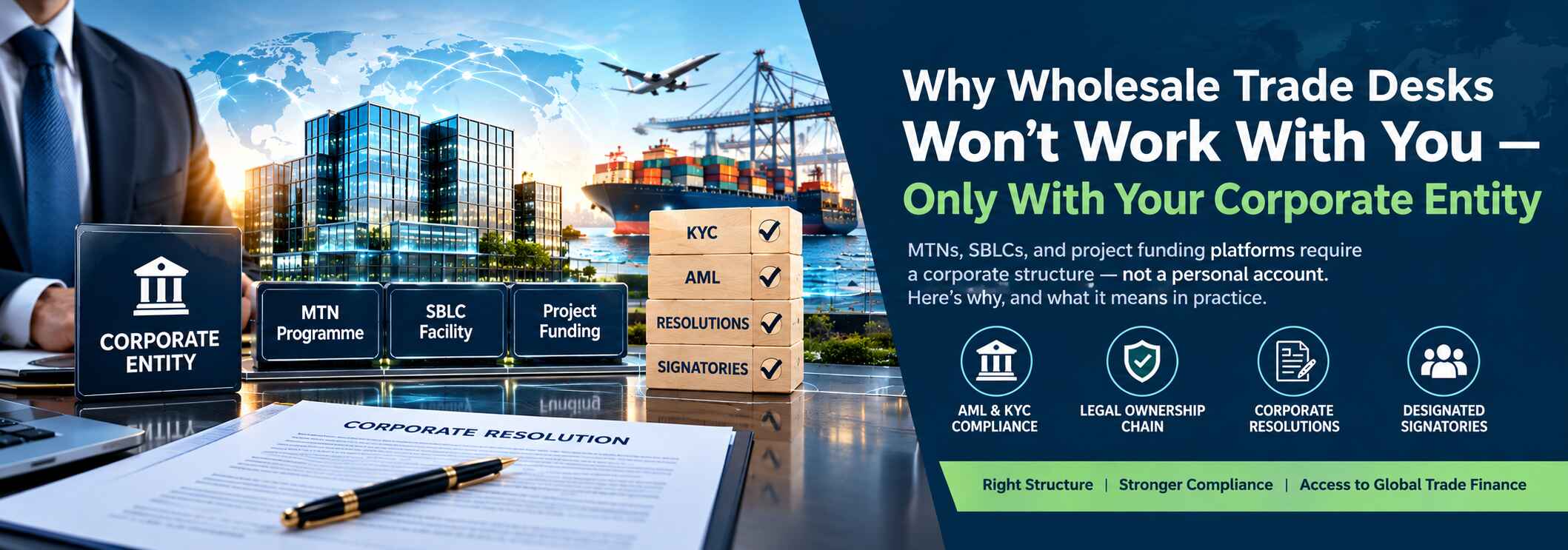
Why Wholesale Trade Desks Require a Corporate Entity

Corporate Entity  |  SPV  |  Wholesale Trade Desk  |  MTN  |  SBLC  |  AML / KYC Compliance  |  Trade Finance  |  Project Funding  |  Institutional Grade Accounts  |  Tier One Settlement  |  Corporate Entity  |  SPV  |  Wholesale Trade Desk  |  MTN  |  SBLC  |  AML / KYC Compliance  |  Trade Finance  |  Project Funding  |  Institutional Grade Accounts  |  Tier One Settlement  | 
Trade Finance  ·  Institutional Structure  ·  AML/KYC

Why Wholesale Trade Desks
Won't Work With You
Only With Your Corporate Entity

Every serious wholesale trade desk — every MTN programme, every SBLC facility, every project funding platform — operates under the same structural requirement. The capital instrument moves through a corporate entity or Special Purpose Vehicle. Not a personal account. Not a private banking relationship. A properly constituted corporate structure. Here is why, and what it means in practice.

Professional Insight 8 min read Trade Finance  ·  Corporate Structure  ·  Wholesale Banking

The most common reason a wholesale trade transaction fails before it begins has nothing to do with the capital, the instrument, or the counterpart. It has to do with the account the client is trying to use.

From professional experience working across wholesale banking, trade finance, and PPP for project funding at the institutional level, one pattern repeats with striking consistency: clients who have the capital, who have found a legitimate trade desk, and who are genuinely positioned to participate in an MTN programme or SBLC Trade for facilitating serious Project Funding — more often than not, find themselves unable to proceed because they are attempting to engage as an individual rather than as a properly constituted corporate entity.

This is not a technicality. It is not a bureaucratic preference. It is a hard structural requirement built directly into the AML, KYC, and compliance frameworks under which every legitimate wholesale trade desk, Tier One settlement bank, and serious trade platform operates.

Understanding why this requirement exists — and what it demands in practice — is the difference between an engagement that proceeds and one that stalls permanently.

The Core Principle

Trade platforms, compliance officers, and Tier One settlement banks operate under microscopic AML and KYC regulation. Moving serious capital instruments requires an institutional-grade account. Corporate accounts provide clear legal ownership chains, authorised corporate resolutions, and designated signatories that retail personal accounts simply cannot cleanly support.

Why Corporate Structure Is Non-Negotiable

The Three Reasons Wholesale Desks Require It

The requirement for a corporate entity or SPV is not arbitrary. It reflects three distinct compliance and operational realities that are built into the institutional infrastructure of wholesale trade finance.

01

Clear Legal Ownership Chains

AML regulations require wholesale counterparts to establish — with documentary certainty — who owns the capital being deployed and who benefits from the transaction. A personal account creates ambiguity that a corporate structure with properly documented Ultimate Beneficial Ownership resolves cleanly. The compliance team at a Tier One settlement bank needs a legal chain they can follow, document, and defend to their regulator. A corporate entity provides that chain. A personal account, in the context of instruments of this scale, does not.

AML Requirement
02

Authorised Corporate Resolutions

Wholesale trade instruments — MTNs, SBLCs, and the associated settlement mechanisms — require authorised signatories acting under documented corporate authority. A Board Resolution or Corporate Resolution authorising the transaction, naming the signatories, and establishing the scope of their authority is a standard prerequisite at every serious trade desk. This documentation does not exist for a personal account. It cannot be retrofitted. It exists only where a properly constituted corporate entity exists first.

KYC Requirement
03

Designated Signatories at Institutional Grade

The movement of capital instruments at wholesale scale requires designated signatories whose authority is legally constituted, verifiable, and specific to the transaction. Compliance officers at trade platforms and Tier One settlement banks will verify signatory authority independently. A corporate structure — correctly constituted, with current statutory documentation — provides this. A personal account, regardless of the wealth behind it, provides only a single individual whose authority to bind a transaction is legally ambiguous at institutional scale.

Institutional Grade Requirement
Professional Observation

In consistent experience across this space, the rejection of a transaction at compliance stage — after significant time has been invested by all parties — almost always traces back to one of two structural failures: the wrong bank, or the absence of an appropriate corporate entity. The capital is present. The appetite is genuine. The structure is missing.

A legitimate wholesale trade desk does not bend this requirement. A desk that claims it will accept a personal account for an MTN or SBLC transaction is telling you something important about its legitimacy.

The Instruments

MTNs and SBLCs — Why Structure Matters Even More

The corporate structure requirement applies across wholesale trade finance broadly. But it carries particular weight in the context of the two instruments most commonly sought by HNWIs accessing wholesale banking for the first time: Medium Term Notes and Standby Letters of Credit.

MTN

Medium Term Note

A debt instrument issued by a financial institution or corporate entity with a maturity typically ranging from one to ten years. In wholesale trade contexts, MTN programmes allow qualified participants to access capital markets at institutional terms — rates and structures unavailable at the retail or private banking level.

MTN programmes are issued to, and traded between, institutional counterparts. The issuing desk will not engage with an individual. The settlement bank will not accept instructions from a personal account. The instrument, by its nature, requires a corporate counterpart on the receiving side.

Why corporate structure is essential: MTN settlement involves interbank messaging between institutional accounts. Personal accounts are not participants in this infrastructure.

SBLC

Standby Letter of Credit

A guarantee instrument issued by a bank on behalf of a client, assuring a beneficiary that payment will be made if the client fails to fulfil a contractual obligation. In trade finance and project funding, SBLCs function as performance and payment guarantees that enable transactions that would otherwise require full capital commitment upfront.

An SBLC is issued on behalf of a corporate entity — not an individual. The issuing bank's compliance team will require full corporate KYC, corporate resolutions authorising the instrument, and designated signatories. The absence of any of these stops the issuance before it begins.

Why corporate structure is essential: the SBLC is a liability of the issuing bank on behalf of your entity. Banks do not issue liabilities on behalf of informal personal relationships.

Personal vs Corporate Account

What a Personal Account Cannot Do

The table below reflects the compliance reality at serious wholesale trade desks and Tier One settlement banks, based on professional experience in this space. It is not a regulatory citation — the specific requirements vary by institution and jurisdiction. It reflects consistent observed practice.

Requirement
Corporate Entity / SPV
Personal Account
UBO documentation
Cleanly structured, legally constituted
Ambiguous at institutional scale
Authorised resolutions
Board / Corporate Resolution available
Cannot be provided
Designated signatories
Legally constituted, verifiable
Individual only — authority ambiguous
MTN programme participation
Eligible counterpart
Not accepted by issuing desks
SBLC issuance
Issued on behalf of entity
Not issued on personal accounts
Tier One settlement
Accepted in interbank infrastructure
Outside institutional messaging rails
AML compliance clearance
Documented ownership chain
Insufficient for instrument scale
Project funding eligibility
Standard structure for project SPV
Not a recognised project counterpart
What to Do About It

The Correct Sequence of Steps

If you are a HNWI seeking access to wholesale trade finance — an MTN programme, an SBLC facility, or project funding at institutional scale — and you do not yet have the right corporate structure in place, the sequence matters as much as the steps themselves. Approaching a trade desk before the structure is ready wastes time, risks relationships, and in some cases permanently closes doors that might otherwise have opened.

  • 01

    Establish the Correct Corporate Entity or SPV

    The entity must be properly constituted in a jurisdiction that is accepted by the trade desk and settlement bank you intend to work with. Jurisdiction selection matters — not all corporate structures carry equal weight in the eyes of institutional compliance teams. This requires specialist legal advice. We advise on the basis that this step must be completed before any approach to a trade desk is made.

  • 02

    Ensure the Entity Has the Right Banking Infrastructure

    A corporate entity without a Tier One correspondent bank account is only half the solution. The entity's operating and settlement account must sit at an institution whose compliance standing is accepted by the wholesale counterpart. This is the precise gap our Tier One Trade Account Opening Service addresses — at the corporate entity level.

  • 03

    Prepare Full Corporate KYC Documentation

    This includes: Certificate of Incorporation, Memorandum and Articles of Association, current statutory registers, UBO declaration and supporting documentation, Board Resolution authorising the transaction and naming designated signatories, and proof of the entity's banking relationship. Every document must be current, certified where required, and prepared to the standard the receiving institution will accept — not the standard a company formation agent produces by default.

  • 04

    Approach the Trade Desk Through the Entity

    Only when the corporate structure is in place and the banking infrastructure is established should the approach to the trade desk be made. The approach should be made through professional channels — an unintroduced direct approach to a serious wholesale trade desk is rarely the right first move, regardless of how well prepared the documentation is.

Where You Are Now

Two Positions. Two Pathways.

✓  Structure in Place

You have a corporate entity and the right banking infrastructure

If your corporate entity is properly constituted, your UBO documentation is current, your authorised resolutions are in place, and your entity holds an account at a qualifying Tier One correspondent bank — you are positioned to approach a serious wholesale trade desk for MTN or SBLC access. The next step is a professional introduction to the right counterpart.

◈  Structure Not Yet in Place

You have the capital. The corporate infrastructure is missing.

If you have the capital and the intent but not the corporate entity, or if your entity lacks the right Tier One banking relationship, the trade desk conversation must wait. The structure comes first. We advise clients at this stage on what is required — and our Tier One Trade Account Opening Service addresses the banking infrastructure component at the corporate entity level specifically.

Transparency

The observations in this article are based on professional experience working in wholesale banking, trade finance, and institutional access — not on published regulatory standards that can be cited directly. Specific requirements vary by institution, jurisdiction, and the nature of the instrument being accessed.

What does not vary, in our experience, is the principle: legitimate wholesale trade desks require corporate entities. Any desk that tells you otherwise warrants careful scrutiny before you proceed further with them.

The corporate and legal structuring steps described here require qualified legal counsel in the relevant jurisdiction. We do not provide legal advice. We advise on the banking infrastructure component — the Tier One account at the corporate entity level — as part of our Tier One Trade Account Opening Service.


This article reflects professional observations in the wholesale banking and trade finance space and does not constitute legal, financial, or regulatory advice. Corporate structuring, instrument eligibility, and compliance requirements vary by jurisdiction, institution, and transaction type. Independent legal and financial advice should be obtained before proceeding with any trade finance or project funding transaction.

Structure First. Trade Second.

If you are ready to discuss the corporate banking infrastructure your entity needs to access wholesale trade finance, a confidential conversation is the right first step.

#TradeFinance #WholesaleBanking #SPV #MTN #SBLC #CorporateStructure #AML #KYC #HNWI #HNWI #ProjectFunding #PrivateWealth #TierOneBanking

Quantum Computing and Cryptocurrency: What You Need to Know

Quantum Computing  |  POST-Quantum Cryptography  |  NIST PQC STANDARDS 2024  |  Bitcoin ECDSA Vunerability  |  ISO 20022  |  CBDC Development  |  Financial Infrastructure  |  SHOR'S Algorithm  |  Quantum Computing  |  Post-Quantum Cryptography  |  NIST PQC Standards 2024  |  Bitcoin ECDSA Vulnerability  |  ISO 20022  |  CBDC Development  |  Financial Infrastructure  |  SHOR'S Algorithm  | 
Quantum Finance  ·  What Is Actually True

Quantum Computing
and Your Money
The Real Story

Quantum technology will reshape financial infrastructure and cryptocurrency security. Not through conspiracy — through physics, cryptography, and the unglamorous work of regulatory standards bodies. Here is what is actually happening, what is genuinely uncertain, and what it means for sophisticated investors.

Technology & Finance 10 min read Quantum Computing  ·  Crypto  ·  Financial Infrastructure

The phrase "quantum financial system" circulates widely online. Almost none of what is written about it is accurate. The actual story — grounded in real physics, real cryptography, and real institutional infrastructure — is more consequential, and more nuanced, than any conspiracy narrative.

This article covers two things that are true, documented, and important for anyone holding significant financial assets to understand: what quantum computing will do to cryptocurrency security, and what the real transformation of global financial infrastructure actually looks like. Both are happening. Neither looks like the internet says it does.

Part One  ·  Quantum Computing & Crypto

What Quantum Computing Actually Is

Classical computers — every laptop, server, and smartphone — process information in binary: each unit of data is either a 0 or a 1. A quantum computer uses quantum bits, or qubits, which can exist in multiple states simultaneously through a property called superposition. Combined with quantum entanglement and interference, this allows a sufficiently powerful quantum computer to solve certain categories of mathematical problem exponentially faster than any classical machine.

The word "certain" is doing important work in that sentence. Quantum computers are not universally faster than classical computers. They are dramatically faster for specific problem types — and two of those problem types are the mathematical foundations on which most modern cryptography, including Bitcoin's security, is built.

The Relevant Algorithm

Shor's Algorithm, published by mathematician Peter Shor in 1994, demonstrates that a quantum computer can solve the integer factorisation problem and the discrete logarithm problem in polynomial time — problems that classical computers require exponential time to solve. These are precisely the problems that underpin RSA encryption and elliptic curve cryptography, the two most widely used cryptographic systems in financial technology and cryptocurrency.

The Specific Threat to Cryptocurrency

Bitcoin's security rests on Elliptic Curve Digital Signature Algorithm — ECDSA. When you send Bitcoin, you use a private key to generate a digital signature that proves ownership without revealing the key itself. The security assumption is that deriving the private key from the public key is computationally infeasible for any classical computer. This assumption is correct — for classical computers.

A quantum computer running Shor's Algorithm could, in principle, derive a private key from a public key. This would allow an attacker to sign transactions on behalf of any wallet whose public key has been exposed — which includes every wallet that has ever sent a transaction, because sending a transaction reveals the public key.

Ethereum, and most other major cryptocurrencies, share the same underlying vulnerability. This is a real, documented cryptographic concern — not speculation.

Quantum Threat Level by Asset / System
Bitcoin (ECDSA wallets with exposed public keys) High — eventual
Public key exposed on every outbound transaction
Ethereum (standard wallets) High — eventual
Same ECDSA dependency as Bitcoin
Bitcoin (unused addresses / never sent) Lower — public key not yet exposed
Public key only exposed at point of spending
Post-quantum resistant cryptocurrencies Low — designed for quantum era
Built on lattice-based or hash-based cryptography
RSA-based banking encryption (TLS, etc.) High — migration underway
NIST post-quantum standards adopted 2024; migration in progress
Uncertain

Timeline: When a quantum computer capable of breaking ECDSA at scale will exist is genuinely contested among researchers. Estimates in published academic and institutional literature range from approximately ten years to thirty years or more. Anyone claiming a specific date is presenting a guess as a fact. The honest position is: the threat is real; the timeline is unknown; preparation should not wait for certainty.

What the Crypto Industry Is Already Doing

The cryptographic community has not been waiting. The National Institute of Standards and Technology — NIST, the US federal body responsible for cryptographic standards — finalised its first set of post-quantum cryptography standards in 2024. These are based on mathematical problems — primarily lattice-based cryptography — that are believed to be resistant to quantum attack.

These standards are verifiable. They are publicly documented. They represent the most authoritative institutional response to the quantum threat currently available.

ML-KEM

Key Encapsulation

Formerly CRYSTALS-Kyber. For securing key exchange — the process by which two parties establish a shared secret over an insecure channel.

ML-DSA

Digital Signatures

Formerly CRYSTALS-Dilithium. The direct replacement for ECDSA in digital signature applications — including, eventually, cryptocurrency transaction signing.

SLH-DSA

Hash-Based Signatures

Formerly SPHINCS+. A stateless hash-based signature scheme offering a different mathematical foundation as an alternative to lattice-based approaches.

What This Means for Your Crypto Portfolio

The question for any serious cryptocurrency holder is not whether quantum computing poses a threat — it does. The question is whether the blockchains and wallets you hold assets in will migrate to post-quantum cryptographic standards before a sufficiently powerful quantum computer exists. Bitcoin and Ethereum both have active research and community discussion on this migration. Neither has completed it. The transition will require network-wide consensus — a historically slow process on both chains. Holders with significant positions should be monitoring this actively, and considering the relative quantum-readiness of any new positions they take.

Part Two  ·  Financial Infrastructure

The Real Transformation of Financial Infrastructure

While conspiracy narratives describe a dramatic overnight replacement of the global financial system, the actual transformation of financial infrastructure is happening in a characteristically unglamorous way: through standards bodies, regulatory frameworks, and interbank messaging protocols.

Two developments are real, documented, and significant for anyone operating at the institutional level of finance.

ISO 20022 — The New Language of Global Finance

ISO 20022 is an international standard for financial messaging — the common language through which banks, payment systems, and financial institutions communicate transaction data with each other. Its predecessor systems, including the legacy SWIFT MT message format, were designed decades ago and carry significant limitations in the richness of data they can transmit.

ISO 20022 replaces this with a structured data format that carries significantly more information per transaction — including richer remittance data, more detailed counterparty information, and machine-readable fields that enable automated compliance screening.

01

Richer Transaction Data

ISO 20022 messages carry structured, machine-readable data fields that legacy formats cannot accommodate. This enables end-to-end transparency of payment purpose, counterparty detail, and remittance information — reducing the manual intervention currently required in cross-border transactions.

02

Enhanced Compliance Capability

The structured data format enables automated AML and sanctions screening at a level of granularity that legacy messaging cannot support. For the institutions and clients in this space, this is significant: richer data means more precise compliance decisions, and fewer false positives that slow legitimate high-value transactions.

03

Foundation for Future Infrastructure

ISO 20022 is the data standard on which central bank digital currency systems and next-generation real-time gross settlement infrastructure are being built. It is not a destination — it is the foundation layer for what comes next in institutional financial infrastructure.

Verify

SWIFT's ISO 20022 migration was underway as of mid-2025. Adoption timelines and completion status across specific institutions and corridors may have progressed since then. For current migration status, SWIFT's own published materials at swift.com are the authoritative primary source. We recommend verifying current figures there rather than relying on any secondary source, including this article.

Central Bank Digital Currencies — What Is Actually Happening

Central Bank Digital Currencies — CBDCs — are digital forms of sovereign currency issued directly by central banks. Unlike cryptocurrency, they are not decentralised. Unlike existing digital bank balances, they are direct liabilities of the central bank rather than commercial banks.

As of mid-2025, a significant number of central banks globally had active CBDC research, pilot, or live deployment programmes. The Bank for International Settlements — the institution that coordinates central bank policy globally — has published extensively on CBDC design and its implications for financial infrastructure.

Why This Matters for Wholesale Banking

Wholesale CBDC — designed for interbank settlement rather than retail use — has particular relevance for the correspondent banking infrastructure this series has covered. A wholesale CBDC operating on ISO 20022-compatible rails would represent a material change to how large-value transactions are settled between institutions. This is not imminent, but it is not theoretical either. Central banks are building it.

Pros & Cons  ·  Post-Quantum Financial Infrastructure

The Honest Pros and Cons

The transition to post-quantum cryptographic standards, combined with ISO 20022 adoption and CBDC development, represents the most significant structural change to financial infrastructure in decades. Like any structural change, it carries genuine benefits and genuine risks.

✓  Genuine Benefits
  • Long-term cryptographic security — post-quantum standards protect financial infrastructure against a threat that will eventually become real, regardless of uncertain timeline.
  • Richer compliance data — ISO 20022's structured format enables more precise AML screening, reducing friction for legitimate high-value transactions.
  • Settlement efficiency — real-time gross settlement on modern infrastructure reduces counterparty risk and settlement lag in wholesale transactions.
  • Reduced correspondent banking friction — richer data reduces the manual intervention currently required in complex cross-border transactions.
  • Foundation for programmable finance — ISO 20022-compatible infrastructure enables smart contract-style automation in institutional contexts.
  • Greater transparency — structured transaction data supports better regulatory oversight without requiring additional reporting burden.
✕  Genuine Risks
  • Transition vulnerability — the period between quantum computers becoming capable and cryptographic migration being complete is the period of highest risk for existing crypto holdings.
  • Migration complexity — blockchain networks require broad consensus to change cryptographic standards. This is slow, contested, and uncertain in outcome.
  • CBDC surveillance risk — programmable sovereign digital currency raises legitimate questions about financial privacy and state oversight that have not been resolved.
  • Infrastructure concentration — ISO 20022 migration consolidates financial messaging around fewer, larger infrastructure providers.
  • Legacy system fragility — institutions still running legacy messaging during migration carry elevated operational and compliance risk.
  • Post-quantum standard uncertainty — NIST's 2024 standards are the best current answer. They may not be the final one. Mathematical cryptography continues to evolve.
Summary
What You Should Take From This

On quantum computing and cryptocurrency: The threat is real and documented. Shor's Algorithm can break ECDSA — the cryptographic foundation of Bitcoin, Ethereum, and most major cryptocurrencies — on a sufficiently powerful quantum computer. That computer does not yet exist. When it will exist is genuinely uncertain, with credible estimates ranging from a decade to several decades. What is not uncertain is that preparation should not wait for certainty. NIST finalised post-quantum cryptography standards in 2024. The question for any serious crypto holder is whether the networks they hold assets in will complete migration before the threat materialises.

On financial infrastructure: The real transformation of global financial infrastructure is happening through ISO 20022 — a structured messaging standard that replaces decades-old formats with richer, machine-readable transaction data. Combined with central bank digital currency development, this represents the most significant change to institutional financial plumbing since SWIFT was established. It is not dramatic. It is not sudden. It is consequential.

On what to watch: For crypto portfolios — monitor Bitcoin and Ethereum's post-quantum migration roadmaps. For institutional finance — follow SWIFT's ISO 20022 adoption progress and BIS publications on wholesale CBDC design. For both — treat the transition period as a period of elevated structural risk, and position accordingly.

What this is not: It is not a replacement of the global financial system overnight. It is not a gold-backed reset. It is not operated by satellite. It is physics, mathematics, and regulatory standards — working slowly, imperfectly, and consequentially, as they always have.

Sources & Verification

The cryptographic claims in this article are based on well-established computer science: Shor's Algorithm (1994), ECDSA vulnerability to quantum attack, and NIST's Post-Quantum Cryptography Standardisation project (finalised standards published 2024). These are verifiable from NIST's own publications at nist.gov.

ISO 20022 is documented at iso20022.org and through SWIFT's published migration materials. CBDC research is documented through the Bank for International Settlements at bis.org. We recommend primary sources for any decisions based on this content.

Timeline estimates for quantum computing capability reflect the range found in academic and institutional literature as of mid-2025. This is a fast-moving field. Current assessments may differ.


This article is for informational purposes only and does not constitute financial, investment, legal, or technical advice. Cryptographic standards, regulatory frameworks, and institutional adoption timelines evolve rapidly. Readers should verify all material claims from primary sources and obtain independent professional advice before making decisions based on this content.

The Future Is Already Being Built

The institutions preparing now — in cryptographic standards, infrastructure, and banking access — will be positioned when the transition accelerates. The question is whether you are one of them.

#QuantumComputing #PostQuantumCryptography #Bitcoin #Ethereum #Crypto #ISO20022 #CBDC #SWIFT #FinancialInfrastructure #WealthManagement #HNWI #NIST

How Digital Bonds Improve Transparency, Security, and Efficiency

Are Digital Bonds the future?

In recent years, there’s been a significant focus on the potential benefits of using blockchain or distributed ledger technology (DLT) in bond markets. Several jurisdictions have adapted frameworks, and the EU and UK are setting up for experimentation. 


Personally, I’m thrilled that several innovative digital bond issuances, such as the Economic Association Blockchain (EAB) and data deals are coming (where the technology is being integrated with data analytics and AI to facilitate new types of data-sharing and management agreements). These transactions attract much attention and interest. Before we delve into the current status and expected legal and market developments, let’s start by understanding how a digital bond differs from traditional or conventional bond.


Digital bonds are bonds that use Distributed Ledger Technology (DLT) for all or part of their life cycle. They can be native digital bonds issued directly on a distributed ledger or security tokens where a traditional bond is issued off-chain and immobilised before ownership or beneficial interests are transferred on-chain. This is known as tokenised bonds. DLT can be used for issuance, transfer, custody, and cancellation of bonds. Communications between issuers and holders including the passage of resolutions and declaration of events, as well as the settlement process. DLT can also be used post-issuance for real-time tracking of proceeds, key performance indicators, and allocation reporting for ESG and sustainability link bonds. The biggest difference between conventional bonds and those cleared and settled through DLT is the replacement of some or all of those processes, depending on the structure and processes being replaced.

In capital markets, DLT adoption is centred around asset classes that benefit most from efficiency gains or innovation and where there’s the biggest market readiness for said innovation. For example, shallow liquidity in OTC trading or workflow inefficiencies (such as manual processes) are the key drivers. The fixed income market is expected to benefit significantly from digitalisation. Operating cost efficiencies, such as reduced back office costs and clearing and settlement costs, are specific advantages of digital bonds. Workflow automation based on smart contracts, like automated coupon payments for digital bonds based on a transparent Ledger of ownership, is another advantage. Fractionalisation reduces minimum ticket sizes, broadening the investor base and opening the bond market to smaller issuers and issuance sizes. Secondary trading advantages include 24×7 trading, improved markets, improved collateral, mobility, and faster settlement cycles. The immutable and transparent nature of the blockchain Ledger increases pellucidity and reduces the risk of fraud, key efficiencies and advantages of DLT.


Blockchain and Distributed Ledger Technology

Stablecoin solutions and other digital assets are being considered, with a focus on building an interoperable ecosystem with multiple solution providers. While regulatory frameworks vary, there’s a general eagerness from regulators to collaborate and establish harmonised systems. Issuing digital bonds, like the FAA digital green bonds, which involves navigating legal complexities, educating stakeholders, and integrating with existing systems, but progress is being made towards streamlining the process.

The development of the digital bond market is driven through education and advocacy, focusing on harmonising global regulatory frameworks, building interoperability, and advancing DLT. The transition from traditional to digital bonds will be gradual, but the market is expected to evolve significantly, complementing the existing DLT ecosystem. Investor demand for digital bonds is growing, though it’s still in the early stages, with a focus on educating investors and building networks to facilitate adoption.


The above highlights the varying treatment of digital bonds across various jurisdictions and the increasing focus on digital assets. The intersection of digital bonds and ESG/sustainability is noteworthy, with green bonds utilising blockchain for transparency and avoidance of greenwashing. For further information please contact me

For more information on the USDT or BTC Trade Program, please contact us:

The Powerful Rise of Crypto and the Future of Digital Finance

Crypto is the WORLD’s financial future / Eric Trump: Bitcoin will crush Wall Street’s old finance system.

Understanding Quantum Computing and Its Impact on Bitcoin Security

Introduction to Quantum Computing and Bitcoin

Quantum computing represents a revolutionary leap in computational power, utilising quantum bits, or qubits, as the fundamental units of information. Unlike classical bits, which represent either a 0 or a 1, qubits can exist in multiple states simultaneously, enabling quantum computers to perform complex calculations at unprecedented speeds. Current quantum computers operate with 100 to 1,000 qubits, but using Quantum Computing and Bitcoin to break Bitcoin’s cryptographic security would require significantly more—estimates suggest between 13 million and 300 million qubits.

Bitcoin, a decentralised digital currency, relies on cryptographic algorithms to secure its transactions and wallets. These algorithms, such as the Elliptic Curve Digital Signature Algorithm (ECDSA), protect private keys that control access to Bitcoin funds.Quantum Computing and Bitcoin However, quantum computers, particularly through algorithms like Shor’s algorithm, could potentially decrypt these keys, posing a threat to Bitcoin’s security.

Can Quantum Computers Recover Lost Bitcoin?

It is estimated that 2.3 million to 3.7 million Bitcoin—approximately 11% to 18% of Bitcoin’s fixed supply of 21 million coins—are permanently lost due to forgotten private keys or inaccessible wallets. A significant portion of these includes the 1 million Bitcoin believed to be held by Bitcoin’s pseudonymous creator, Satoshi Nakamoto, in dormant wallets.

Quantum computers and Bitcoin could theoretically recover these lost coins by cracking the cryptographic keys protecting these wallets, particularly those using older pay-to-public-key (P2PK) formats. These early Bitcoin addresses expose their public keys, making them vulnerable to quantum attacks. If such coins were reintroduced into circulation, it could lead to significant market volatility, impacting Bitcoin’s value due to its fixed supply and scarcity-driven economics.

Example Scenario: Imagine a quantum computer unlocking Satoshi Nakamoto’s wallet, releasing 1 million Bitcoin into the market. This sudden increase in circulating supply could disrupt Bitcoin’s price stability and investor confidence.

Economic and Ethical Implications

The recovery of lost Bitcoin raises important economic and ethical questions:

  • Economic Impact: Bitcoin’s value is tied to its scarcity. Reintroducing millions of lost coins could dilute this scarcity, potentially lowering Bitcoin’s market value and affecting investors and users.
  • Ethical Considerations: Should recovered Bitcoin be reintroduced, destroyed, or redistributed? Experts like Bitcoin developer Jameson Lopp argue that lost coins should be “burned” (permanently removed) to preserve Bitcoin’s economic model. Others propose redistributing recovered coins to promote wealth equity, though this could undermine trust in the network.

In May 2025, BlackRock, a global asset manager, highlighted these risks in its iShares Bitcoin Trust (IBIT) filing, warning that quantum computing could undermine Bitcoin’s long-term security by breaking its cryptographic defenses.

Protecting Your Bitcoin from Quantum Threats

While quantum computers capable of breaking Bitcoin’s security are not yet available, users can take proactive steps to safeguard their funds against future threats and existing vulnerabilities, such as phishing scams. Approximately 25% of Bitcoin is stored in vulnerable P2PK or reused pay-to-public-key-hash (P2PKH) addresses, which expose public keys and are susceptible to quantum attacks.

Best Practices for Bitcoin Security:

  1. Avoid Address Reuse: Reusing a Bitcoin address exposes its public key, increasing vulnerability to quantum attacks. Use wallets that automatically generate new addresses for each transaction.
  2. Adopt Modern Wallet Formats: Use wallets supporting SegWit(Segregated Witness) or Taproot, which offer enhanced security and reduce public key exposure.
  3. Beware of Phishing Scams:
    • Address Poisoning: Scammers send small transactions from addresses mimicking legitimate ones, tricking users into copying fraudulent addresses. Always verify wallet addresses before sending funds.
    • Zero-Value Scams: Fraudulent addresses are added to a wallet’s transaction history, leading users to accidentally send funds to scammers. Double-check addresses during transactions.
  4. Stay Vigilant: Regularly update your wallet software and follow best practices for securing private keys, such as using hardware wallets or secure backups.

Bitcoin’s Quantum Resistance: Current and Future Solutions

Bitcoin’s decentralised and open-source nature allows it to adapt to emerging threats. Ongoing research is focused on developing quantum-resistant wallets and cryptographic techniques to protect Bitcoin’s future. For example:

  • Quantum-Resistant Asset Mapping Protocol (QRAMP): Proposed by Bitcoin developer Agustin Cruz in early 2025, QRAMP aims to protect Bitcoin from quantum risks while enabling cross-chain functionality with other blockchains, preserving custody and supply limits.
  • Advanced Cryptography: Researchers are exploring quantum-resistant cryptographic algorithms, such as lattice-based cryptography, which could enhance Bitcoin’s scalability, create unhackable wallets, and strengthen network security.

While Bitcoin remains secure against current quantum capabilities, users should adopt best practices to minimise risks. The development of quantum-resistant protocols ensures that Bitcoin can evolve to thrive in a quantum computing era.

Key Takeaways

  • Quantum computers, with enough qubits, could potentially crack Bitcoin’s cryptographic keys, recovering lost coins and impacting market dynamics.
  • Vulnerable wallets, particularly those using older P2PK formats or reused addresses, are at higher risk.
  • Users can protect their Bitcoin by avoiding address reuse, adopting SegWit or Taproot wallets, and staying vigilant against phishing scams.
  • Ongoing research, such as QRAMP and quantum-resistant cryptography, is strengthening Bitcoin’s resilience to future quantum threats.

By understanding these risks and taking proactive measures, Bitcoin users can safeguard their assets and contribute to the network’s long-term security in the face of advancing quantum technology.

Alternatively to mitigate risk for HNWI with large wallets, see our article: Bitcoin Trade Program

Colossal Bitcoin ROI from a USDT or BTC Trade Program

What Is Tether (USDT)? 

Tether (USDT) stands as a prominent stablecoin in the cryptocurrency market, uniquely pegged to the U.S. dollar to mitigate the volatility typical of digital currencies. Issued by Tether, under the umbrella of iFinex, which also operates BitFinex, USDT provides stability through its reserves in U.S. dollars.

USDT Trade Program

USDT Trade Program

Widely traded across various cryptocurrency exchanges and platforms. Recent data shows USDT’s price is around $1.00, with a 24-hour trading volume of billions of dollars. You can trade USDT on platforms like BinanceKraken, and Revolut, often against other cryptocurrencies or fiat currencies like GBP. 

By March 2024, it emerged as the third-largest cryptocurrency by market capitalisation, after Bitcoin and Ethereum, and maintained its position as the leading stablecoin with nearly $99 billion in market capitalisation. Throughout 2023 and into 2024, USDT accounted for the majority of cryptocurrency exchange transactions by volume, underscoring its critical role in the crypto ecosystem.

Interested in a Wallet to Wallet USDT Trade Program, with bullets, rolls and extensions. Contact us to find out more about an ‘invite only’ opportunity for HNWI. Structured to run over 30 days with possible rolls and extensions, aiming to provide a very attractive ROI, for Crypto Wealth Enhancement. The basic parameters and procedures for the trade are as follows:

USDT Trade Program

Minimum Wallet requirement $51m USDT and larger is a prerequisite for entry.

ROI – TBA with the Desk on application.

Pay-Out Mode, Bitcoin USDT (within an hour of allotted time) alternatively Wire Transfer to (fiat within 48hrs).

Historical Profits to be discussed on Application. 

Clients are responsible for their own Due Diligence, on referred Crypto Traders and Platforms (as ONLY the Client may have a relationship with any Crypto Trader). Vital receive remuneration from our clients success only. We confirm that Crypto clients cannot lose or risk their own Crypto Capital from our referred Trades or from A/B testing. Furthermore, this is not a solicitation and we insist clients ensure their Trader demonstrates all Trades via the blockchain. Blockchain explorer should be used to locate each transaction and verify it has actually been recorded on the public ledger. Each transaction page then serves as an immutable, publicly verifiable proof of Trade.

Six Step Application Procedure for USDT Trade Program:

1. Client Submits Full Personal CIS, with client email and WhatsApp number along with LOI with both A Wallet (500 coin minimum) address and QR code. Also B (private empty wallet) address both needed for approval. 

2. Client performs an AB test (Pre-Compliance given code) following submission of file and approval of wallets.

3. Client performs an AB test (with Platform’s given code) following submission of file and approval of wallets.

4. Forensic Analysis of Investor wallet and A/B test is done within 2 hours. If due-diligence is positive, the Trade Manager issues a Trade Contract;

5. Post contract signature by both Parties, Investor performs a second AB test prior to Trade Commencement.

6. Trading starts within 2 (two) banking hours, following Contract signature by both parties.

For more information on the USDT IOLTA entry, please contact us