

Private Placement Programs otherwise known as PPP’s.
How do Private Placement Programs (PPP’s) work?
Definition and Operation of Private Placement Programs (PPP)

Private Placement Programs for Green Project Funding
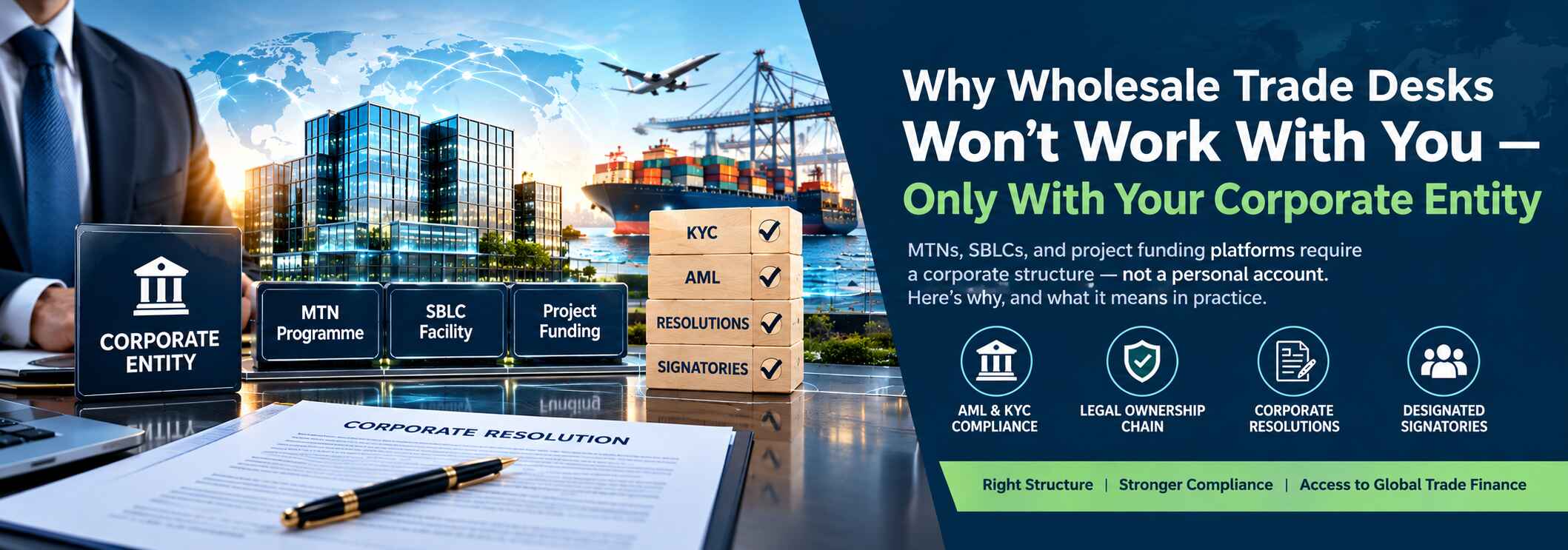
A Private Placement Program (PPP), often referred to as a “high yield investment program,” is a specialised investment mechanism that facilitates the trading of bank assets such as Standby Letters of Credit (SBLCs) and Medium Term Notes. An SBLC serves as a guarantee made by a Bank on behalf of a client, also regularly used to “preserve” a line of credit, demonstrating financial solvency and or guaranteeing a payment to a creditor. The PPP also typically trades in Medium Term Notes (MTNs), as debt instruments that typically mature within five to ten years. These notes are acquired at a significant discount to their face value and are sold at a higher price in the secondary market, allowing PPP investors to profit from the differential.
PPPs typically span 40 banking weeks and are designed to generate project funding and wealth accumulation through structured trades. These trades involve predetermined buy and sell agreements, minimizing the risk of failure. This process can be likened to a scenario where an individual purchases a car for £20,000 with a prearranged agreement to sell it for £21,000, thus guaranteeing a profit of £1,000. This prearranged buying and selling, known as “arbitrage,” is a cornerstone of PPPs, ensuring secure and predictable transactions within the private market.
Arbitrage and Leverage
Transactions within a Private Placement Programs are inherently secure due to their arbitrage nature, meaning financial instruments are bought and resold immediately at pre-set prices. These instruments are not sold directly in the open market but rather through a network of market participants. Banks benefit from these operations through the interest generated by the credit lines extended to the operators and from commissions on each transaction, leveraging their involvement for indirect gains.
Profitability of PPP’s
While individual trades in a PPP might yield modest percentages, the frequency of trades can result in substantial cumulative profits. Multiple trades can be executed within a week or even a single day, leading to significant gains. This type of investment carries a low risk profile (especially when utilising Tier 1 UK Banks) and is distinct from traditional stock trading. PPPs generally offer exceptional returns, often ranging from 50% to 100% per week, making them an attractive option for financing large-scale projects.
Minimum Deposit Requirements
Typically, participation in a PPP is reserved for Ultra High Net Worth Individuals (UHNWI) with a minimum investment requirement of $100 million. However, current market conditions have made it possible to see higher returns. These opportunities are currently available due to global liquidity challenges, so are subject to change based on market conditions. For me personally, this is the first time in eighteen years that I have ever come across a level of protection normally only available with $100m in top global banks.
Key advantages of PPPs include the absence of any need to move funds, provided they are held in a top 50 world bank account. Investors also maintain complete control over their funds, which remain in their own Company or Private bank account, without blocks, liens, or any encumbrance.
Assets accepted in a PPP transaction
Different types of assets can be used in a PPP transaction, including:
- PoF signed by two Bank Officers for $100m+
- Durable goods: precious metals, gold, silver, platinum, diamonds, art collections, etc.
- “In-ground” assets: precious metals and stones (gold, silver, diamonds, emeralds, etc.)
- Bank guarantee (BG).
- Standby letters of credit (SBLC or Standby Letter of Credit).
- Medium term notes, etc.
If you are serious about your Project Funding, or merely interested in further wealth creation and you have the minimum capital requirement, or alternatively are able to introduce an investor who perhaps will share part of their profits to fund your project, please simply use either the Skype or LinkedIn logos below to login and leave me a message. Hereafter, I will revert ASAP.
Alternatively see our Wholesale Banking Article
About The Author





About the author