

Imagine having $100 million in liquid assets and being told, politely but firmly, that you cannot open the Wholesale Banking account. Not because of what you have — but because of where it sits.
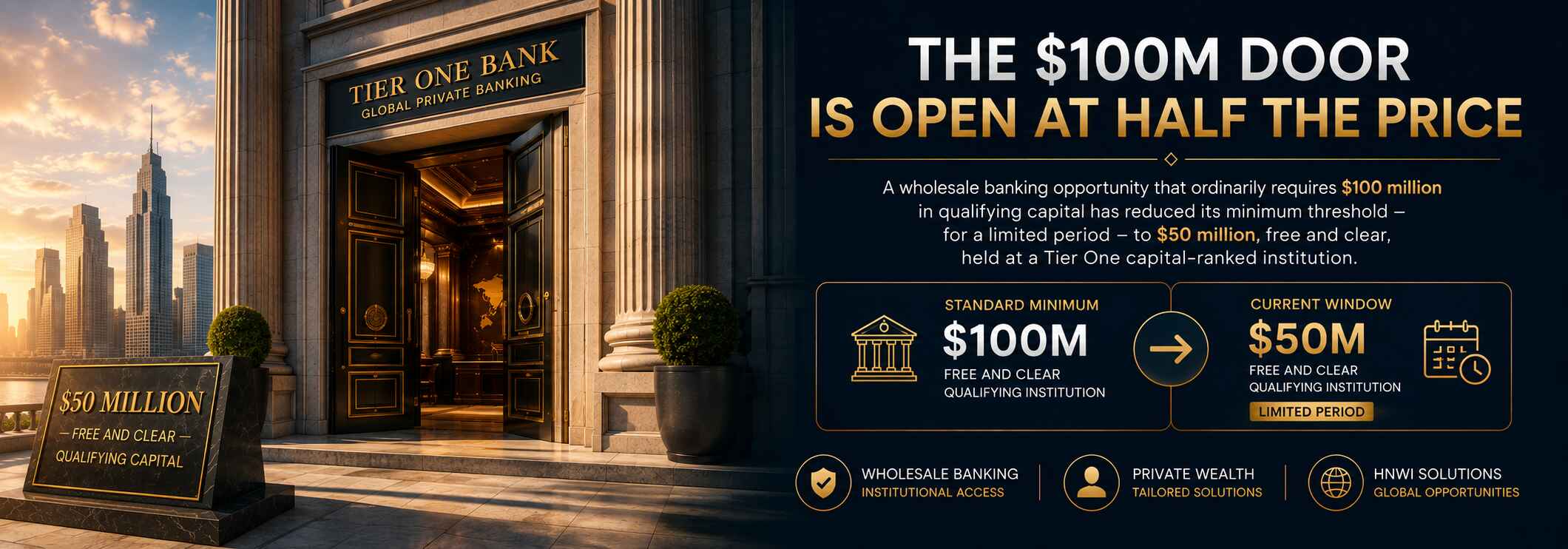
There is a persistent myth in private wealth circles. It goes something like this: wholesale banking — the institutional tier of financial services reserved for sophisticated investors and large-scale capital deployment — is inaccessible to most High Net Worth Individuals simply because of minimum investment thresholds. Meet the capital requirement, the thinking goes, and the door swings open.
This is wrong. And understanding why it is wrong is the most important thing anyone managing serious wealth — or advising those who do — can know right now.
What Wholesale Banking Actually Is
Wholesale Banking operates at the intersection of institutional finance and high-capital private clients. It includes access to non-retail investment products, interbank markets, large-scale funding facilities, structured products, and — critically — rates and terms that simply are not available at the retail or even private banking level.
Regulators define wholesale clients differently across jurisdictions, but the common thread is sophistication and scale. In the UK, the FCA's "professional client" category; in Australia, the Corporations Act's "wholesale client" designation; in the EU, MiFID II's classification framework. Each sets thresholds — in net assets, investment portfolio size, or transaction volume.
On paper, many HNWI's qualify. In practice, tens of thousands of them cannot access these services.
The capital is there. The sophistication is there. The legal classification is there. What is missing is a piece of infrastructure so mundane that almost no one thinks to ask about it — until they are already turned away.
The Assumption Everyone Makes
When HNWI's are told they cannot participate in a wholesale product, a fund structure, or an institutional investment vehicle, the instinctive response from advisers, intermediaries, and the clients themselves is to look at the numbers. "Do we meet the minimum?" "Can we aggregate positions across entities?"
These are the wrong questions — or rather, they are the second questions. There is a prior question that stops everything before it starts, and it sits not in the wealth management layer of the conversation but in the compliance and onboarding layer of the receiving institution.
The Real Obstacle: The Tier-One Bank Account
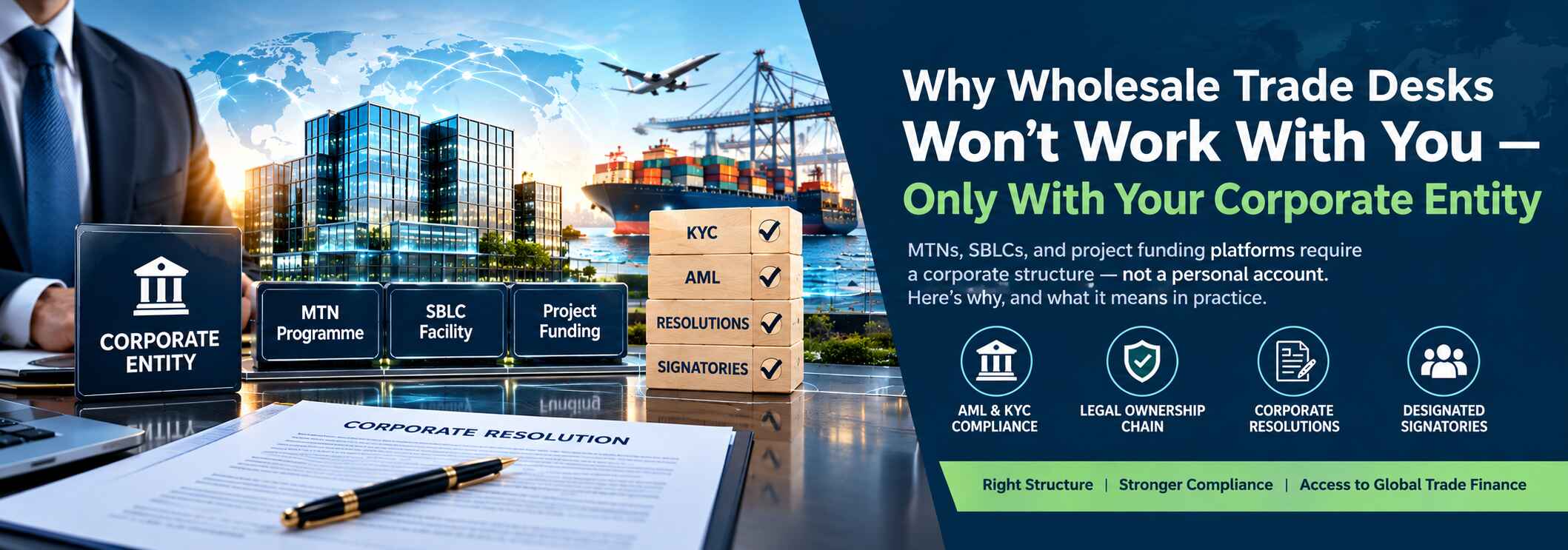
Here is what the bankers do not tell you. To be onboarded as a wholesale banking client at a major institutional bank, a custodian, a prime broker, or a serious alternative investment manager, you will almost certainly be required to demonstrate that your settlement and operating funds sit in an appropriate Tier-One bank account.
We are talking about specific bank accounts held at US institutions like JPMorgan (Investment Banking side only, not Chase), BoA, Wells Fargo, UBS - New York. In the UK Barclays or HSBC from their London HQ's only, or in Europe UBS, Deutsche Bank, Crédit Agricole, or DBS in Singapore. These Banks must sit at the top of the global correspondent banking network. Banks whose compliance infrastructure, AML frameworks, and KYC standards are considered — by the institutions receiving your capital — to be an acceptable guarantee of the provenance and legitimacy of funds.
The logic is straightforward from an institutional risk perspective: if a major correspondent bank has already done the due diligence to hold your money, the receiving institution can rely — at least in part — on that prior gatekeeping. It dramatically reduces their own compliance burden. It is a form of delegated trust.
But for the HNWI standing at the door? It is a bureaucratic wall that has nothing to do with their wealth, their sophistication, or their intent.
Why Many HNWI's Simply Don't Have One
This is where the story gets genuinely interesting — and genuinely frustrating. The global population of High Net Worth Individuals is extraordinarily diverse. Wealthy individuals from emerging markets, from certain industries, from particular nationalities, or with complex multi-jurisdictional structures frequently find that major Tier-One banks will not open accounts for them — or have closed accounts they previously held.
The reasons are well-documented but rarely spoken plainly:
- Risk Tier-One banks have engaged in sustained de-risking since 2012, shedding client relationships from higher-risk jurisdictions to reduce regulatory exposure and the cost of compliance.
- PEPs Politically Exposed Persons — a category broader than many realise — face extreme onboarding friction at major banks, regardless of the legitimacy of their wealth. Again there are solutions for more information get in touch
- Origin Wealth derived from industries or geographies that carry heightened scrutiny (natural resources in certain regions, real estate in specific markets, cash-intensive businesses) creates a documentation burden that large retail compliance teams simply do not want to process.
- Structure Complex ownership structures — trusts, foundations, multi-layered holding companies — make UBO (Ultimate Beneficial Ownership) identification difficult enough that banks reject applications rather than resource the work.
- Scale Major banks have become highly selective about which private clients they serve at all. The profitability calculation for onboarding complex HNWI's has, for many institutions, simply not made sense at the retail or even private banking level.
The cruel irony is clear: the very clients who have the capital to access wholesale markets are, in many cases, the same clients whose profiles make Tier-One banking hardest to obtain. The gate that was supposed to signal legitimacy has become a mechanism of exclusion that has nothing to do with legitimacy at all.
Wholesale banking isn't blocked by a lack of capital. It's blocked by a lack of the right banking relationship — and that relationship has become increasingly difficult to establish for the very clients who need it most.
What This Means in Practice
Picture a client with $100 million in liquid assets, a portfolio of international real estate, and a successful business. They want to access a structured funding facility or project funding through wholesale banking. They have been referred by an adviser who has done the work. They meet every regulatory definition of a sophisticated investor.
The institution asks: where are the funds currently held? The client names a regional private bank, a family office custodian, or a jurisdiction-specific institution. The wholesale lender's compliance team looks at that and sees not an obstacle to be worked around, but a liability to be avoided. The application stalls. Often, it dies.
This is not theoretical. It happens constantly. Advisers who work in this space see it routinely. The client cannot understand why having the money is not enough. The adviser cannot explain it without making the compliance system sound arbitrary, because in many ways, it is.
The Conversation the Industry Needs to Have
There are solutions — some structural, some advisory. Alternative correspondent banking relationships, bridging structures, introduction networks between vetted regional banks and institutional counterparts, and the increasingly active space of specialist compliance consultancy that focuses specifically on getting the right banking infrastructure in place before wholesale access is sought.
But solutions require first acknowledging the problem — and the problem is not being spoken about clearly enough. The wealth management industry, broadly speaking, still leads with the capital conversation when it should be starting with the banking infrastructure conversation.
If you are advising wealthy clients, or if you are a wealthy client: before any conversation about accessing wholesale markets, ask the banking question. Where does the money live? How does the receiving institution view that address? What is the chain of correspondent banking trust that connects your assets to the institutions you want to work with?
The capital is rarely the obstacle. The plumbing is.
This article reflects the author's professional observations across the private wealth and institutional banking sectors. It does not constitute financial or legal advice. Regulatory classifications and institutional policies vary by juristiction. For HNWI's needing a Tier One Bank Account opening service, please contact the author via our website email forms, or alternatively LinkedIn. Make sure to supply a WhatsApp number your email plus a precis of your requirement. Wholesale Banking minimum entry conditons apply.
Drop a comment below, or share this with someone navigating wholesale access for the first time. The conversation matters.




About the author