
The most common reason a wholesale trade transaction fails before it begins has nothing to do with the capital, the instrument, or the counterpart. It has to do with the account the client is trying to use.
From professional experience working across wholesale banking, trade finance, and PPP for project funding at the institutional level, one pattern repeats with striking consistency: clients who have the capital, who have found a legitimate trade desk, and who are genuinely positioned to participate in an MTN programme or SBLC Trade for facilitating serious Project Funding — more often than not, find themselves unable to proceed because they are attempting to engage as an individual rather than as a properly constituted corporate entity.
This is not a technicality. It is not a bureaucratic preference. It is a hard structural requirement built directly into the AML, KYC, and compliance frameworks under which every legitimate wholesale trade desk, Tier One settlement bank, and serious trade platform operates.
Understanding why this requirement exists — and what it demands in practice — is the difference between an engagement that proceeds and one that stalls permanently.
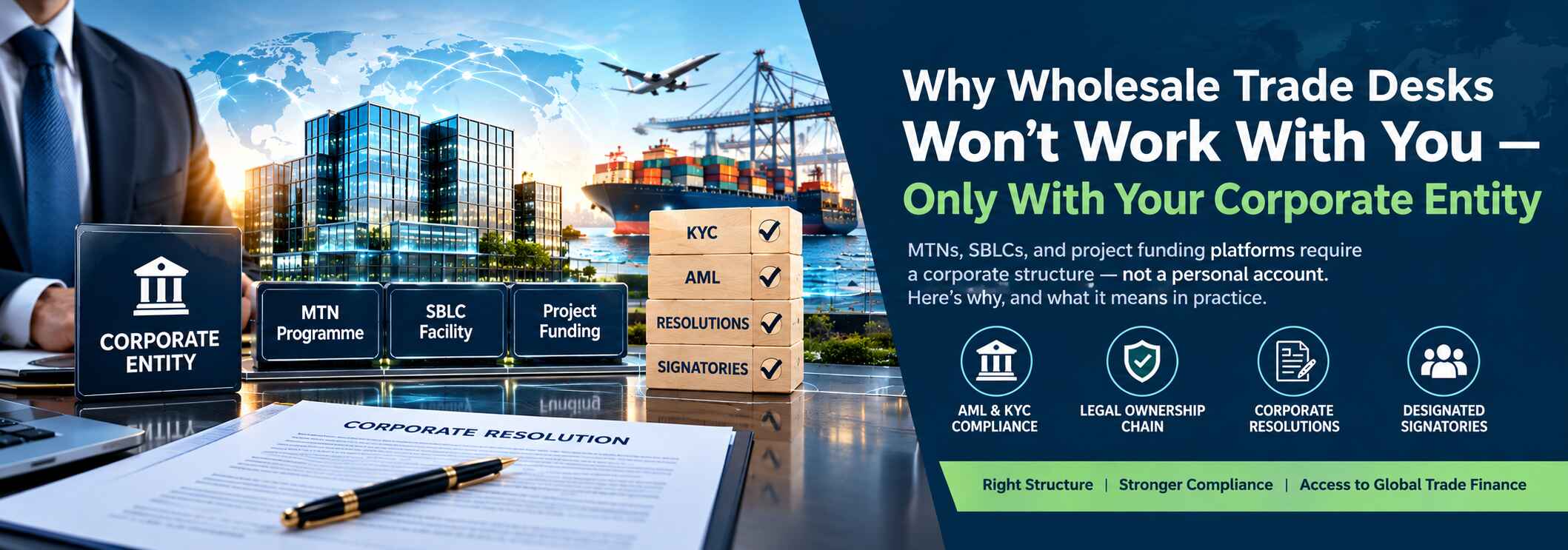
Trade platforms, compliance officers, and Tier One settlement banks operate under microscopic AML and KYC regulation. Moving serious capital instruments requires an institutional-grade account. Corporate accounts provide clear legal ownership chains, authorised corporate resolutions, and designated signatories that retail personal accounts simply cannot cleanly support.
The Three Reasons Wholesale Desks Require It
The requirement for a corporate entity or SPV is not arbitrary. It reflects three distinct compliance and operational realities that are built into the institutional infrastructure of wholesale trade finance.
Clear Legal Ownership Chains
AML regulations require wholesale counterparts to establish — with documentary certainty — who owns the capital being deployed and who benefits from the transaction. A personal account creates ambiguity that a corporate structure with properly documented Ultimate Beneficial Ownership resolves cleanly. The compliance team at a Tier One settlement bank needs a legal chain they can follow, document, and defend to their regulator. A corporate entity provides that chain. A personal account, in the context of instruments of this scale, does not.
AML RequirementAuthorised Corporate Resolutions
Wholesale trade instruments — MTNs, SBLCs, and the associated settlement mechanisms — require authorised signatories acting under documented corporate authority. A Board Resolution or Corporate Resolution authorising the transaction, naming the signatories, and establishing the scope of their authority is a standard prerequisite at every serious trade desk. This documentation does not exist for a personal account. It cannot be retrofitted. It exists only where a properly constituted corporate entity exists first.
KYC RequirementDesignated Signatories at Institutional Grade
The movement of capital instruments at wholesale scale requires designated signatories whose authority is legally constituted, verifiable, and specific to the transaction. Compliance officers at trade platforms and Tier One settlement banks will verify signatory authority independently. A corporate structure — correctly constituted, with current statutory documentation — provides this. A personal account, regardless of the wealth behind it, provides only a single individual whose authority to bind a transaction is legally ambiguous at institutional scale.
Institutional Grade RequirementIn consistent experience across this space, the rejection of a transaction at compliance stage — after significant time has been invested by all parties — almost always traces back to one of two structural failures: the wrong bank, or the absence of an appropriate corporate entity. The capital is present. The appetite is genuine. The structure is missing.
A legitimate wholesale trade desk does not bend this requirement. A desk that claims it will accept a personal account for an MTN or SBLC transaction is telling you something important about its legitimacy.
MTNs and SBLCs — Why Structure Matters Even More
The corporate structure requirement applies across wholesale trade finance broadly. But it carries particular weight in the context of the two instruments most commonly sought by HNWIs accessing wholesale banking for the first time: Medium Term Notes and Standby Letters of Credit.
Medium Term Note
A debt instrument issued by a financial institution or corporate entity with a maturity typically ranging from one to ten years. In wholesale trade contexts, MTN programmes allow qualified participants to access capital markets at institutional terms — rates and structures unavailable at the retail or private banking level.
MTN programmes are issued to, and traded between, institutional counterparts. The issuing desk will not engage with an individual. The settlement bank will not accept instructions from a personal account. The instrument, by its nature, requires a corporate counterpart on the receiving side.
Why corporate structure is essential: MTN settlement involves interbank messaging between institutional accounts. Personal accounts are not participants in this infrastructure.
Standby Letter of Credit
A guarantee instrument issued by a bank on behalf of a client, assuring a beneficiary that payment will be made if the client fails to fulfil a contractual obligation. In trade finance and project funding, SBLCs function as performance and payment guarantees that enable transactions that would otherwise require full capital commitment upfront.
An SBLC is issued on behalf of a corporate entity — not an individual. The issuing bank's compliance team will require full corporate KYC, corporate resolutions authorising the instrument, and designated signatories. The absence of any of these stops the issuance before it begins.
Why corporate structure is essential: the SBLC is a liability of the issuing bank on behalf of your entity. Banks do not issue liabilities on behalf of informal personal relationships.
What a Personal Account Cannot Do
The table below reflects the compliance reality at serious wholesale trade desks and Tier One settlement banks, based on professional experience in this space. It is not a regulatory citation — the specific requirements vary by institution and jurisdiction. It reflects consistent observed practice.
The Correct Sequence of Steps
If you are a HNWI seeking access to wholesale trade finance — an MTN programme, an SBLC facility, or project funding at institutional scale — and you do not yet have the right corporate structure in place, the sequence matters as much as the steps themselves. Approaching a trade desk before the structure is ready wastes time, risks relationships, and in some cases permanently closes doors that might otherwise have opened.
-
01
Establish the Correct Corporate Entity or SPV
The entity must be properly constituted in a jurisdiction that is accepted by the trade desk and settlement bank you intend to work with. Jurisdiction selection matters — not all corporate structures carry equal weight in the eyes of institutional compliance teams. This requires specialist legal advice. We advise on the basis that this step must be completed before any approach to a trade desk is made.
-
02
Ensure the Entity Has the Right Banking Infrastructure
A corporate entity without a Tier One correspondent bank account is only half the solution. The entity's operating and settlement account must sit at an institution whose compliance standing is accepted by the wholesale counterpart. This is the precise gap our Tier One Trade Account Opening Service addresses — at the corporate entity level.
-
03
Prepare Full Corporate KYC Documentation
This includes: Certificate of Incorporation, Memorandum and Articles of Association, current statutory registers, UBO declaration and supporting documentation, Board Resolution authorising the transaction and naming designated signatories, and proof of the entity's banking relationship. Every document must be current, certified where required, and prepared to the standard the receiving institution will accept — not the standard a company formation agent produces by default.
-
04
Approach the Trade Desk Through the Entity
Only when the corporate structure is in place and the banking infrastructure is established should the approach to the trade desk be made. The approach should be made through professional channels — an unintroduced direct approach to a serious wholesale trade desk is rarely the right first move, regardless of how well prepared the documentation is.
Two Positions. Two Pathways.
You have a corporate entity and the right banking infrastructure
If your corporate entity is properly constituted, your UBO documentation is current, your authorised resolutions are in place, and your entity holds an account at a qualifying Tier One correspondent bank — you are positioned to approach a serious wholesale trade desk for MTN or SBLC access. The next step is a professional introduction to the right counterpart.
You have the capital. The corporate infrastructure is missing.
If you have the capital and the intent but not the corporate entity, or if your entity lacks the right Tier One banking relationship, the trade desk conversation must wait. The structure comes first. We advise clients at this stage on what is required — and our Tier One Trade Account Opening Service addresses the banking infrastructure component at the corporate entity level specifically.
The observations in this article are based on professional experience working in wholesale banking, trade finance, and institutional access — not on published regulatory standards that can be cited directly. Specific requirements vary by institution, jurisdiction, and the nature of the instrument being accessed.
What does not vary, in our experience, is the principle: legitimate wholesale trade desks require corporate entities. Any desk that tells you otherwise warrants careful scrutiny before you proceed further with them.
The corporate and legal structuring steps described here require qualified legal counsel in the relevant jurisdiction. We do not provide legal advice. We advise on the banking infrastructure component — the Tier One account at the corporate entity level — as part of our Tier One Trade Account Opening Service.
This article reflects professional observations in the wholesale banking and trade finance space and does not constitute legal, financial, or regulatory advice. Corporate structuring, instrument eligibility, and compliance requirements vary by jurisdiction, institution, and transaction type. Independent legal and financial advice should be obtained before proceeding with any trade finance or project funding transaction.
Structure First. Trade Second.
If you are ready to discuss the corporate banking infrastructure your entity needs to access wholesale trade finance, a confidential conversation is the right first step.