
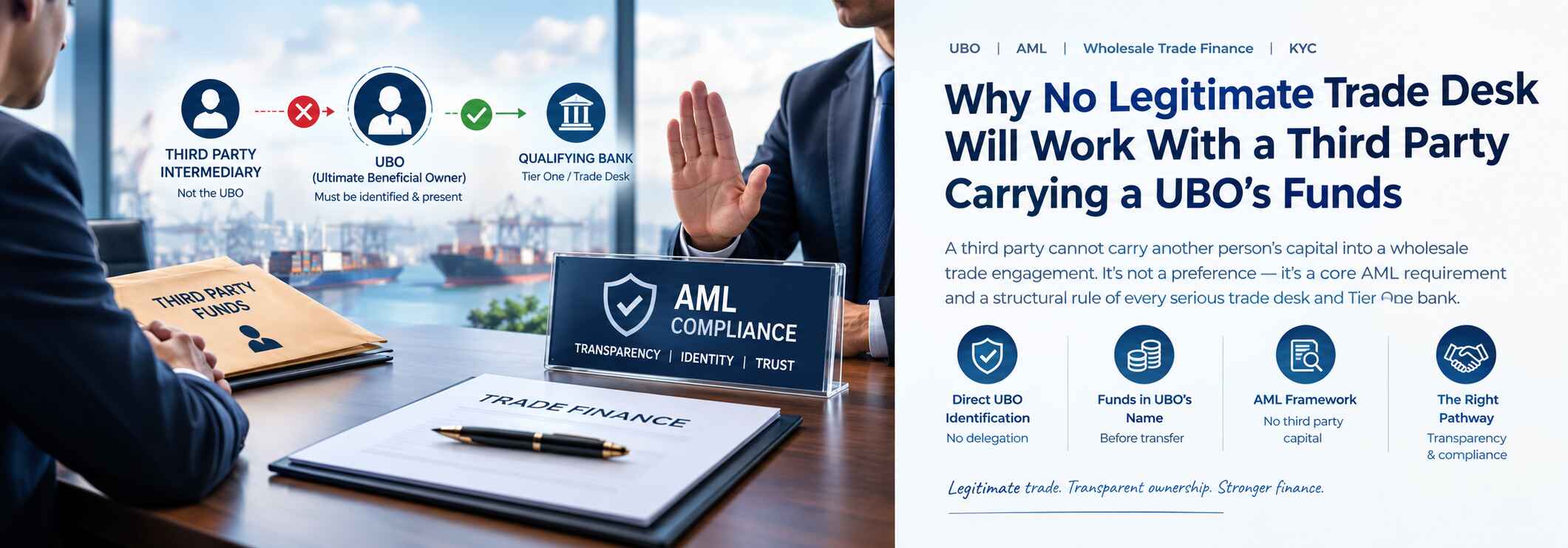
A third party cannot carry another person's capital into a wholesale trade engagement. This is not a preference of the trade desk. It is a structural requirement of every AML framework that governs how serious capital instruments move at the institutional level.
In professional experience across wholesale banking and trade finance, one pattern of failure repeats with a consistency that is both striking and avoidable: an intermediary — often well-intentioned, sometimes with a genuinely promising project — arrives at a trade desk carrying funds that belong to someone else. They have the project. They have the relationship. They have, they believe, the capital.
What they do not have is the one thing no legitimate trade desk can proceed without: the Ultimate Beneficial Owner, present, identified, and in direct control of their own funds — in the right banking infrastructure — before any transfer occurs.
This article explains what this means, why it matters, and — importantly — what the correct pathway looks like for each of the three groups most affected by this misunderstanding.
Who Is the UBO — and Who Is the Intermediary
The person whose money it actually is
The UBO is the natural person who ultimately owns or controls the funds being deployed. In AML regulation, identifying the UBO is not a technicality — it is the entire point of the KYC process. A legitimate trade desk, compliance officer, and Tier One settlement bank must be able to identify, verify, and document the UBO with certainty before any capital instrument moves.
The person who is not the UBO
An intermediary may have a genuine project, a genuine relationship with the UBO, and a genuine desire to participate in wholesale trade finance. What they do not have is the legal standing to present another person's funds at a trade desk. Regardless of any private arrangement between the intermediary and the UBO, the compliance infrastructure of wholesale banking does not recognise that arrangement as sufficient. The UBO must be present and identified directly.
Anti-Money Laundering regulation exists specifically to prevent funds from being moved through layers of representation that obscure their origin and ownership. A third party presenting on behalf of a UBO — however honestly — creates exactly the structure that AML compliance is designed to scrutinise most carefully. It does not matter that the intent is legitimate. The structure itself triggers the compliance concern. Every serious trade desk and Tier One settlement bank operates under this framework.
Why This Breaches Every AML Condition
The specific AML conditions that a third-party-plus-UBO-funds arrangement violates are not obscure. They are the foundational requirements of institutional compliance. Understanding each one makes clear why no legitimate trade desk has discretion to waive them — even where the underlying transaction is entirely genuine.
-
Breach
Direct UBO Identification Cannot Be Delegated
AML frameworks require the institution to identify and verify the UBO directly — not through a representative, not through documentation provided by a third party, and not on the basis of a private agreement between the UBO and an intermediary. The compliance team must be satisfied that the person in front of them is the person whose funds are moving. A third party, by definition, is not that person.
-
Breach
Funds Must Be in the UBO's Name Before Transfer
Before any transfer to a qualifying Tier One bank can occur, the funds must already sit in an account held in the UBO's name — or in a properly constituted corporate entity where the UBO is the documented beneficial owner. A third party cannot transfer funds on behalf of a UBO. The transfer instruction must come from the UBO's own account, under the UBO's own authority. This is not a procedural preference. It is the compliance record that the receiving institution is legally required to hold.
-
Breach
No Legitimate Trade Desk Accepts Third Party Capital
A serious wholesale trade desk will not accept capital presented by an intermediary as belonging to a UBO who is not present and directly engaged in the process. Doing so would expose the trade desk to regulatory liability for facilitating a structure that obscures beneficial ownership — regardless of the actual legitimacy of the underlying funds. This is why the refusal is not negotiable and is not a matter of the desk's preference.
-
Breach
The Intermediary's Project Does Not Change the Requirement
Intermediaries sometimes believe that the quality of their project — its commercial merit, its structure, its returns — is relevant to this conversation. It is not. The project and the capital are evaluated separately. A compelling project presented with improperly structured capital does not become compliant because the project is good. The capital compliance question must be resolved first, independently, before any project discussion is meaningful.
When a third party presents with a UBO's funds at a serious wholesale trade desk, one of two things happens. Either the desk identifies the structure immediately and declines — costing everyone time and potentially damaging the UBO's future prospects with that institution. Or the desk does not identify it immediately, the process advances, and the compliance team identifies it later — at which point the reputational damage is greater and the path back is harder. There is no version of this where the structure works. There is only early discovery and late discovery.
What the Right Process Actually Looks Like
The correct sequence for a UBO who wishes to access wholesale trade finance — including where an intermediary has introduced the opportunity — is straightforward. The complexity is not in the steps. It is in ensuring the steps happen in the right order, with the right infrastructure in place at each stage.
The UBO identifies themselves directly
The engagement with the trade desk must be initiated by the UBO — not on their behalf, not through a representative, but directly. The UBO is the client. The trade desk's compliance process begins with the UBO's identity, not the intermediary's introduction.
RequiredFunds are confirmed in the UBO's account at their current bank
Before any transfer discussion begins, the funds must be confirmed as sitting in an account in the UBO's name — or their correctly structured corporate entity — at their existing institution. The compliance record of where the funds currently sit is part of the source-of-funds documentation the trade desk will require.
RequiredThe UBO is identified at the qualifying Tier One bank before transfer
Before funds move to a qualifying Tier One bank, the UBO must be identified and onboarded at that institution. The transfer cannot precede the identification. The UBO's account at the Tier One bank must exist and be in their name before funds arrive. This is the step most frequently misunderstood — the bank account must be established first, the funds transferred second.
Critical sequenceWhat must never happen: transfer first, identify later
Transferring funds to a new account before the UBO has been properly identified and onboarded at the receiving institution is the structural error that triggers the most serious compliance concerns. It creates a movement of funds whose beneficial ownership cannot be cleanly established at the point of receipt. No legitimate institution will accept this. Any instruction to transfer funds before identity is established should be treated as a serious warning sign.
AML ViolationThe UBO approaches the trade desk directly — or through a properly structured introduction
Once the UBO is identified, their funds are at the right institution, and their corporate structure is in place, the approach to the trade desk can be made. An intermediary may still play a role at this stage — as an introducer, not as a principal. The distinction matters legally and practically.
RequiredThree Audiences. Three Different Lessons.
Your project has value. Your role needs to change.
If you have a genuine project and a genuine UBO relationship, your value is in the introduction and the structure — not in presenting capital that isn't yours. The right role for an intermediary in wholesale trade finance is as an introducer of a properly prepared UBO, not as a principal presenting another person's funds. Repositioning your role correctly is what converts a stalled engagement into a live one.
Your funds cannot speak for themselves through someone else.
If you have capital you wish to deploy through wholesale trade finance, you must be present and directly engaged in the process. An intermediary cannot represent you in the compliance process, however trusted they are. The trade desk's legal obligation is to you — not to anyone acting on your behalf. Your direct participation is not optional. It is the compliance requirement that every other step depends on.
A new pathway is available — and it starts with your institution.
For qualified advisers and wealth managers, a separate and significant opportunity is now available — one that does not require your client to be the UBO of separately held capital. Read the section below.
Trading From Bank Credit Lines — A Separate Pathway for Advisers
For advisers and wealth managers who have been following this series, a significant development is worth understanding clearly. A pathway is now available — for a limited period — that allows qualified advisers and wealth managers to access wholesale trade participation using their firm's or institution's existing bank credit lines as the qualifying instrument.
This is structurally different from the UBO pathway described above. It does not require the adviser's client to be the UBO of separately held capital. It requires the adviser or their institution to hold a qualifying credit line at an acceptable Tier One bank — and to structure that credit line in the way the trade platform requires.
Bank Credit Line Trading — Qualifying Criteria
- Minimum credit line: $100 million, confirmed and available at the qualifying institution
- Institution: Must be held at a Tier One bank — specifically a bank ranking within the top 35 globally by Tier One capital, excluding Chinese, Russian, and Middle Eastern institutions
- Structure: The credit line must be constituted in the specific way the trade platform requires — we advise on exactly how to structure it for acceptance
- Entity: The credit line must sit within a properly constituted corporate entity with full AML/KYC documentation in place
- Direct engagement: The qualifying institution or adviser must engage directly — the same UBO identification principles apply at the institutional level
We advise qualifying advisers and wealth managers on how to structure their credit line correctly for acceptance on this platform. The structuring guidance is specific, practical, and provided as part of our engagement — not as a generic overview.
◈ Available for a limited period onlyInstitutional credit lines, held at qualifying Tier One banks and constituted within properly documented corporate structures, satisfy the AML and KYC requirements of the trade platform in a way that is structurally distinct from individual capital. The institution's own compliance standing, combined with the credit line's documentation, provides the chain of institutional trust that the platform requires. This is a different instrument, requiring a different approach — but grounded in the same compliance principles that govern every other pathway described in this series.
The observations about UBO identification and third-party intermediary limitations in this article reflect professional experience across wholesale banking and trade finance. The specific AML requirements described are consistent with international AML frameworks — but the precise obligations vary by jurisdiction, institution, and instrument. Advisers and UBOs should obtain independent legal and compliance advice appropriate to their specific circumstances.
The bank credit line trading pathway is available for a limited period and subject to qualifying criteria being met. We do not guarantee access or outcomes. Eligibility is confirmed through a direct engagement, not in advance through published content.
This article is for educational purposes and reflects professional observations in wholesale banking and trade finance. It does not constitute legal, financial, or regulatory advice. AML and KYC requirements vary by jurisdiction and institution. All pathways described are subject to eligibility assessment. Independent professional advice should be obtained before proceeding with any wholesale trade finance transaction.
Know Which Pathway Is Yours
Whether you are a UBO, an intermediary repositioning your role, or an adviser exploring the credit line pathway — the right first step is a confidential conversation about where you actually stand.